
Motion as Medicine: How Movement May Support Joint Health
Nov 09, 2026
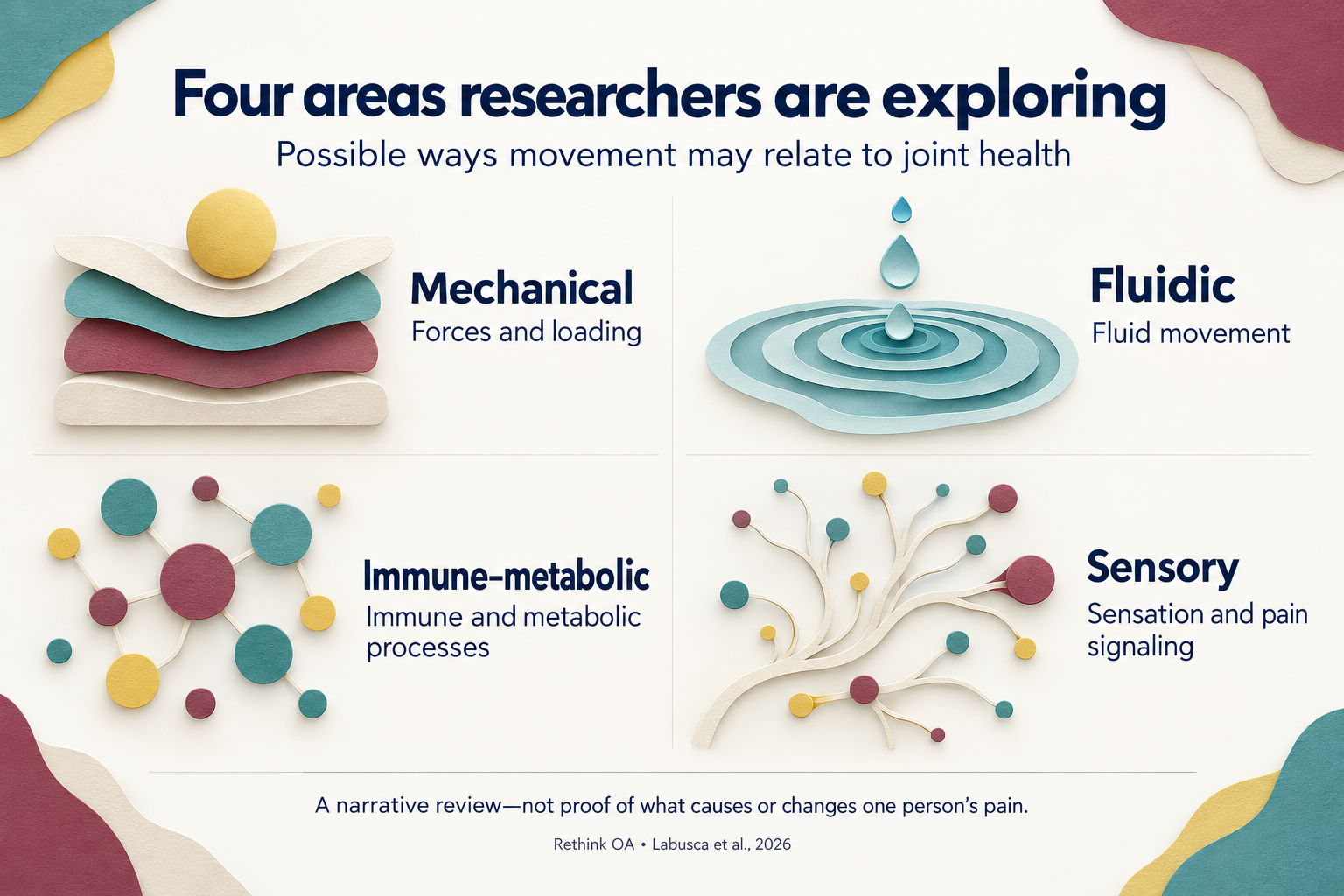
Movement may support a joint in several ways. A narrative review called Motion as Medicine brings together research on mechanical loading, joint fluid, immune and metabolic processes, and sensory input.
The authors explore how these processes might contribute to joint health and pain. That is useful background, but it is not an explanation of exactly what is happening in any one person’s knee.
A narrative review brings existing research together. It is not a new clinical trial testing an intervention. The proposed mechanisms should be read as possibilities to investigate, rather than proof that a particular movement changes pain in a particular way.
A proposed loading window
The authors describe an “adaptive loading window”: a way of thinking about how movement and loading might support adaptation within an individual’s circumstances. They explicitly describe it as a hypothesis-generating framework, not a clinically validated threshold.
That distinction matters. The review cannot tell us that there is a universally wide safe zone, how much movement belongs in it for you, or whether a particular episode of pain means you have crossed its boundary.
What about pain sensitivity?
The review includes sensory input among the areas it explores. The authors discuss possible connections between movement and sensory processes. That conceptual framework cannot identify why your own symptoms change after getting up.
We should also avoid the suggestion that resting, protecting a joint or feeling worried necessarily makes its nerves more sensitive. A proposed mechanism cannot establish what is happening in your body, and pain is not evidence that you have approached movement with the wrong mindset.
What to bring into a care conversation
For practical osteoarthritis care, NICE recommends exercise tailored to a person’s needs. Its guidance explains that pain can initially increase when starting therapeutic exercise, while regular, consistent exercise can improve pain and function over time.
That does not mean every pain response should be ignored. Ask your care team what changes to expect, which symptoms should prompt a review, and how to adapt your plan. A single rule about symptoms settling within 24 hours cannot establish that a dose was appropriate for everyone.
Your daily circumstances matter, too. If cold weather or darker evenings make your usual routine harder, ask about suitable alternatives. Discuss frequency and duration as part of a plan tailored to your needs. The useful question is what approach fits your needs and circumstances.
Final Thoughts
The review offers ideas about how movement may support joint health. Clinical guidance helps connect the broader evidence to care, and your questions and experience help make that care relevant to you.
Rethink OA is an evidence-based mindset program that supports and encourages movement. It does not prescribe an exercise plan, and its clinical trial did not validate the loading window proposed in this review.
FAQ
Why might my knee feel different after moving?
The review discusses several possible processes, including joint fluid and sensory input. It cannot identify the reason for an individual’s symptom change.
Does movement recalibrate pain sensitivity?
Sensory processes are one area the authors explore. This does not establish that every comfortable movement reduces sensitivity or that someone’s pain has a single mechanism.
How much movement is right for me?
The review does not provide a validated individual dose. Ask your care team about an appropriate plan and how to respond to changes in symptoms.
Is moving a little often always better than a longer session?
Discuss the frequency and duration of movement with your care team. Your preferences, needs and circumstances should inform the plan.
What can a narrative review tell us?
It can organize existing research, explore explanations and identify questions for further study. Proposed mechanisms are not the same as proof of an individual treatment effect.
About the Author
Melissa Boswell, PhD, is a bioengineer and digital health founder with nearly a decade of experience working in osteoarthritis, movement science, and human performance. She is the founder of Rethink OA, an evidence-based mindset program developed from research conducted with collaborators at Stanford University and published in npj Digital Medicine. Her work focuses on helping people better understand pain, movement, and behavior change in osteoarthritis.

References
- Labusca L, et al. Motion as Medicine: Physical Activity, Joint Sensitivity, and Pain Management—A Narrative Review. Medical Sciences. 2026;14(4):495. https://doi.org/10.3390/medsci14040495
- National Institute for Health and Care Excellence. Osteoarthritis in over 16s: diagnosis and management. NICE guideline NG226. Recommendations 1.3.1–1.3.4. https://www.nice.org.uk/guidance/ng226/chapter/recommendations
Move More. Fear Pain Less.
Learn how to reduce pain, stay active, and support your joints—starting today.