
5 Steps to Get Back to Exercising When You Have Knee Pain
Jul 20, 2026
If knee pain has kept you from exercising, you already know the hardest part isn’t finding a workout plan. It’s the uncertainty. Will this make things worse? How much is too much? What if it hurts? Those questions stop more people than the pain itself.
Here’s the encouraging news: exercise is the most consistently recommended treatment for knee osteoarthritis in every major clinical guideline, and research suggests it’s safe—a 2025 review of 217 randomized trials found no increase in adverse events across any exercise type studied. The challenge isn’t whether to move again. It’s how to restart in a way you can actually sustain. These five steps come from what the research—and the people who successfully return to activity—consistently show.
Step 1: Redefine What Counts as Exercise
Many people believe exercise only “counts” if it’s a gym session, a long run, or thirty sweaty minutes on a machine. That belief sets an impossibly high bar for a body that’s been resting—and it makes starting feel like a cliff instead of a step.
In reality, movement is movement. Walking to the mailbox, gardening, dancing in the kitchen, climbing your stairs, getting up and down from a chair—all of it loads your muscles and joints in useful ways. Research on knee osteoarthritis suggests that no single type of activity is required to improve symptoms; walking, cycling, swimming, strength training, yoga, and tai chi have all shown benefits. That’s good news, because it means you get to choose the entry point that feels doable today. (If exercise has felt like a chore, I wrote about how to make it feel more enjoyable.)
Step 2: Start Lower Than You Think You Need To
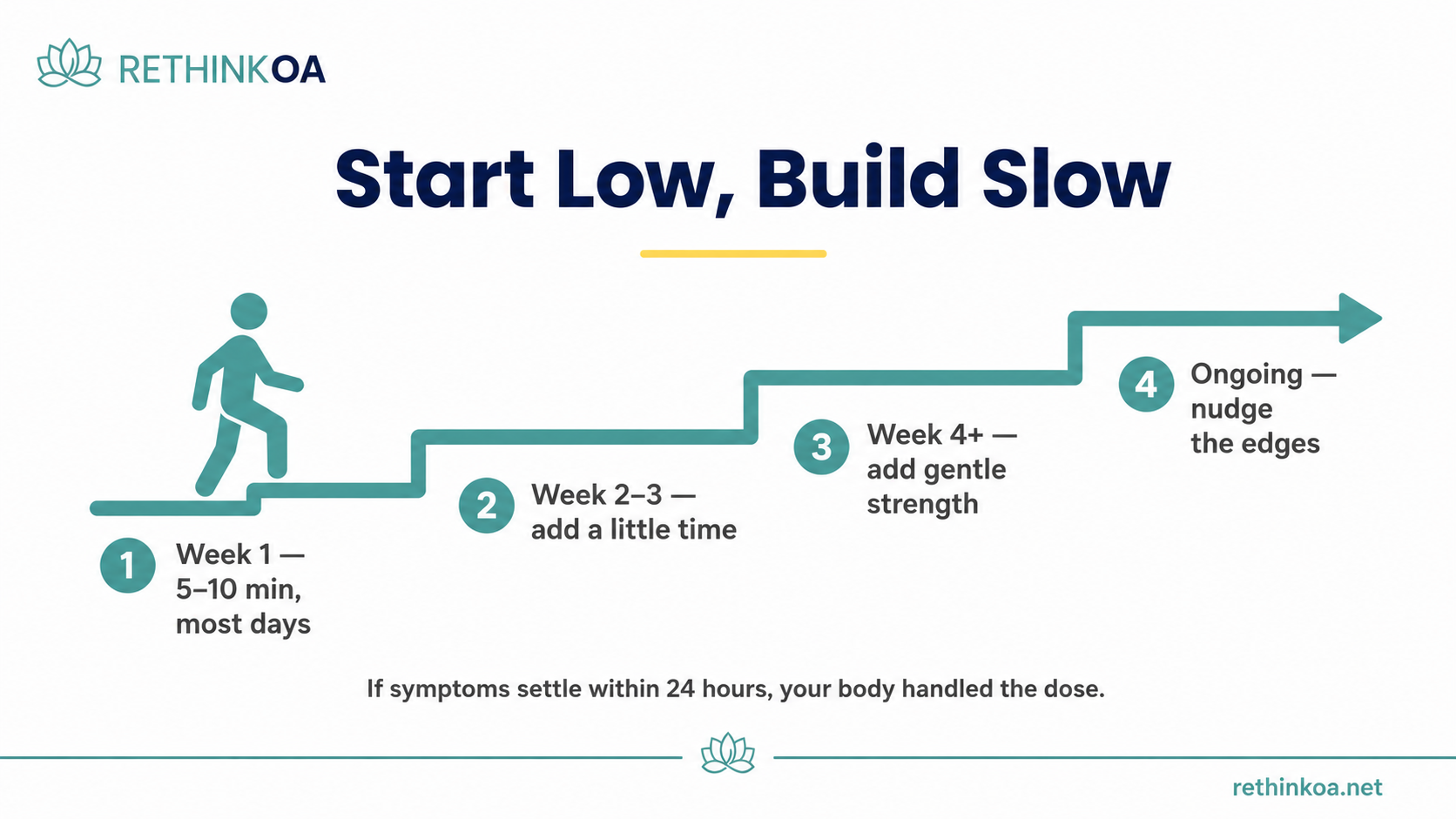
The most common way people fail at returning to exercise is starting at the level they used to be, feeling a flare, and concluding their body can’t handle movement. The problem wasn’t the movement. It was the dose.
Think of it like sun exposure after a long winter: your skin isn’t fragile, it just needs gradual exposure. Muscles, tendons, and joints adapt the same way. Start with an amount you’re confident you can complete—five or ten minutes of walking, a few sit-to-stands, one gentle set of exercises—and build from there. Research suggests that shorter, more frequent bouts of activity are a very reasonable way to accumulate benefits, and structured programs like Denmark’s GLA:D program show meaningful improvements with just two sessions per week over eight weeks. Small is not a compromise. Small is the strategy.
Step 3: Use the 24-Hour Rule for Pain
Some discomfort during or after exercise is normal and expected—especially at first. It does not mean you’re damaging your joint. Research suggests that appropriately dosed exercise does not harm knee cartilage and may actually support joint health.
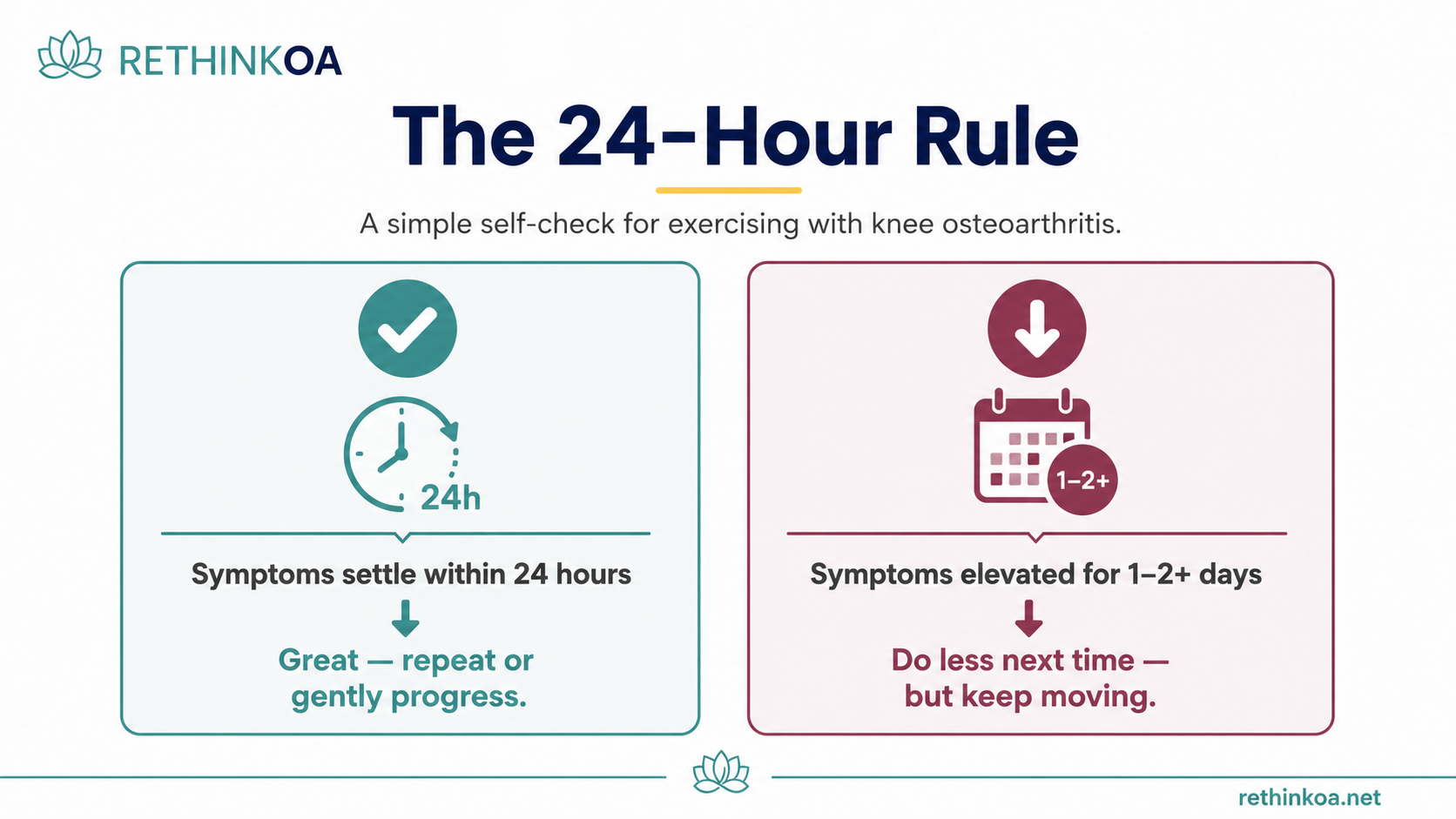
A practical guideline many clinicians and exercise programs use: notice how your knee feels the day after activity. If any increase in symptoms settles back to your usual level within about 24 hours, your body handled that dose—you can repeat or gently progress it. If pain is noticeably worse for more than a day or two, don’t stop moving altogether; just reduce the amount or try a different activity next time. I think of this as “nudging the edges” of what’s comfortable: not avoiding all discomfort, not pushing through sharp pain—just gradually expanding your boundary. Over time, that boundary genuinely widens.
Step 4: Anchor It to Something You Already Do (and Enjoy)
Motivation gets you started; habit keeps you going. The easiest habits attach to routines that already exist—a short walk after breakfast, exercises during your favorite show, stretching while the coffee brews. Behavioral research consistently suggests that convenience and enjoyment predict whether people stick with activity far better than willpower does.
Enjoyment isn’t a bonus feature here—it’s a clinical tool. When movement is social, pleasant, or meaningful, you’ll do more of it, and the benefits compound. Walk with a friend. Take the scenic route. Put on music from your twenties. Whatever makes you look forward to it counts double.
Step 5: Track Small Wins—They Rebuild Confidence
This last step may be the most important. After a long break from exercise, the biggest thing you’ve lost usually isn’t fitness. It’s confidence—what researchers call self-efficacy, and it’s one of the strongest psychological predictors of how people do with osteoarthritis over time.
Confidence is rebuilt with evidence, and small wins are that evidence. Write down what you did: “Walked 10 minutes. Knee was fine the next day.” Each entry is proof that your body is more capable than fear suggests. In our clinical study of the Rethink OA program, published in npj Digital Medicine, this shift—changing how people think about pain, exercise, and their own capability—was associated with increased physical activity and reduced fear of movement. What you believe about your body shapes what you do with it.
Putting It Together
Getting back to exercising with knee pain isn’t about toughness, and it isn’t about finding the perfect program. It’s about starting smaller than your pride wants, listening to your body without obeying its every worry, and letting each small success rebuild the confidence that pain took away. Movement is still yours. It never stopped being yours.
If you want help with the mindset side of this—understanding your pain and rebuilding trust in your body—that’s exactly what Rethink OA was designed and clinically tested to do.
FAQ
Is it safe to exercise with knee pain from osteoarthritis?
For most people, yes. Exercise is the first-line recommended treatment for knee osteoarthritis in major clinical guidelines, and a 2025 review of 217 randomized trials found no increased risk of adverse events with exercise. Some discomfort during or after activity is normal and doesn’t indicate joint damage. That said, everyone’s situation is different—if you have significant health concerns or new, severe symptoms, check in with your clinician before starting.
How do I start exercising again after a long break with knee osteoarthritis?
Start with a dose you’re confident you can complete—often much smaller than you think, like 5–10 minutes of walking or a few simple strength movements. Use the 24-hour rule: if symptoms settle within a day, repeat or slightly progress; if not, reduce the dose rather than stopping. Attach movement to existing routines and choose activities you enjoy, since enjoyment strongly predicts consistency.
What is the 24-hour rule for exercising with arthritis?
It’s a practical self-check used in many osteoarthritis exercise programs: some increase in symptoms during or after exercise is acceptable if things return to your usual baseline within about 24 hours. If pain stays elevated longer than a day or two, the dose was likely too high—do less next time or switch activities, but keep moving.
What exercise is best for knee osteoarthritis?
Research suggests many types help—walking, cycling, swimming, strength training, yoga, and tai chi have all shown benefits. A large 2025 analysis found aerobic exercise performed best on average for pain and function, but the differences don’t change the practical answer: the best exercise is one you enjoy enough to keep doing, at a dose your body can adapt to.
Why am I afraid to exercise even though I know it helps?
Fear of movement is extremely common in osteoarthritis, especially if past activity was painful or you’ve been told your joint is “wearing out.” The fear makes sense—but pain doesn’t always mean harm, and avoidance tends to make both pain and fear grow over time. Rebuilding usually starts with small, safe wins that give your brain new evidence about what your body can do.
About the Author
Melissa Boswell, PhD, is a bioengineer and digital health founder with nearly a decade of experience working in osteoarthritis, movement science, and human performance. She is the founder of Rethink OA, a clinically validated digital program developed from research conducted with collaborators at Stanford University and published in npj Digital Medicine. Her work focuses on helping people better understand pain, movement, and behavior change in osteoarthritis.

References
- Kolasinski SL, et al. 2019 American College of Rheumatology/Arthritis Foundation Guideline for the Management of Osteoarthritis of the Hand, Hip, and Knee. Arthritis Care Res. 2020;72(2):149-162. https://pubmed.ncbi.nlm.nih.gov/31908163/
- Yan L, et al. Comparative efficacy and safety of exercise modalities in knee osteoarthritis: systematic review and network meta-analysis. BMJ. 2025;391:e085242. https://doi.org/10.1136/bmj-2025-085242
- Skou ST, Roos EM. Good Life with osteoArthritis in Denmark (GLA:D). BMC Musculoskelet Disord. 2017;18(1):72. https://pubmed.ncbi.nlm.nih.gov/28173795/
- Bricca A, et al. Impact of exercise on articular cartilage in people at risk of, or with established, knee osteoarthritis: a systematic review of randomised controlled trials. Br J Sports Med. 2019;53(15):940-947. https://bjsm.bmj.com/content/53/15/940
- Boswell MA, et al. Mindset and physical activity intervention for adults with knee osteoarthritis. npj Digital Medicine. 2024. https://www.nature.com/articles/s41746-024-01281-8
- National Institute of Arthritis and Musculoskeletal and Skin Diseases (NIAMS). Osteoarthritis. https://www.niams.nih.gov/health-topics/osteoarthritis
Move More. Fear Pain Less.
Learn how to reduce pain, stay active, and support your joints—starting today.