
Research Spotlight: The Best Type of Exercise for Knee Osteoarthritis, According to 217 Trials
Aug 17, 2026
“I know I should exercise… but what kind?” It’s one of the most common questions in knee osteoarthritis—and until recently, honest answers were fuzzy. Guidelines say “exercise,” but rarely say which type works best. Strength training? Walking? Yoga? Water aerobics? Everyone seems to have an opinion.
Now we have one of the clearest answers to date. A massive analysis published in The BMJ—one of the world’s leading medical journals—pooled data from 217 randomized controlled trials to compare exercise types head-to-head. In this month’s research spotlight, I’ll walk through what the researchers found, what it means for you, and the one caveat that matters more than the rankings.
The Study: 217 Trials, More Than 15,000 People
The research team behind this network meta-analysis gathered randomized trials of exercise for knee osteoarthritis published between 1990 and 2024—217 studies including 15,684 participants in total. A network meta-analysis is a method that compares multiple treatments simultaneously, even when they weren’t tested in the same trial, and ranks them against each other.
They grouped exercise into six categories: aerobic (walking, cycling, swimming), strengthening, flexibility, mind-body (yoga, tai chi), neuromotor (balance and coordination), and mixed programs. Then they compared each type’s effect on the outcomes that matter most to people—pain, physical function, walking ability, and quality of life—at roughly 4, 12, and 24 weeks. The evidence was graded for certainty using the standard GRADE system.
The Result: Aerobic Exercise Took the Top Spot
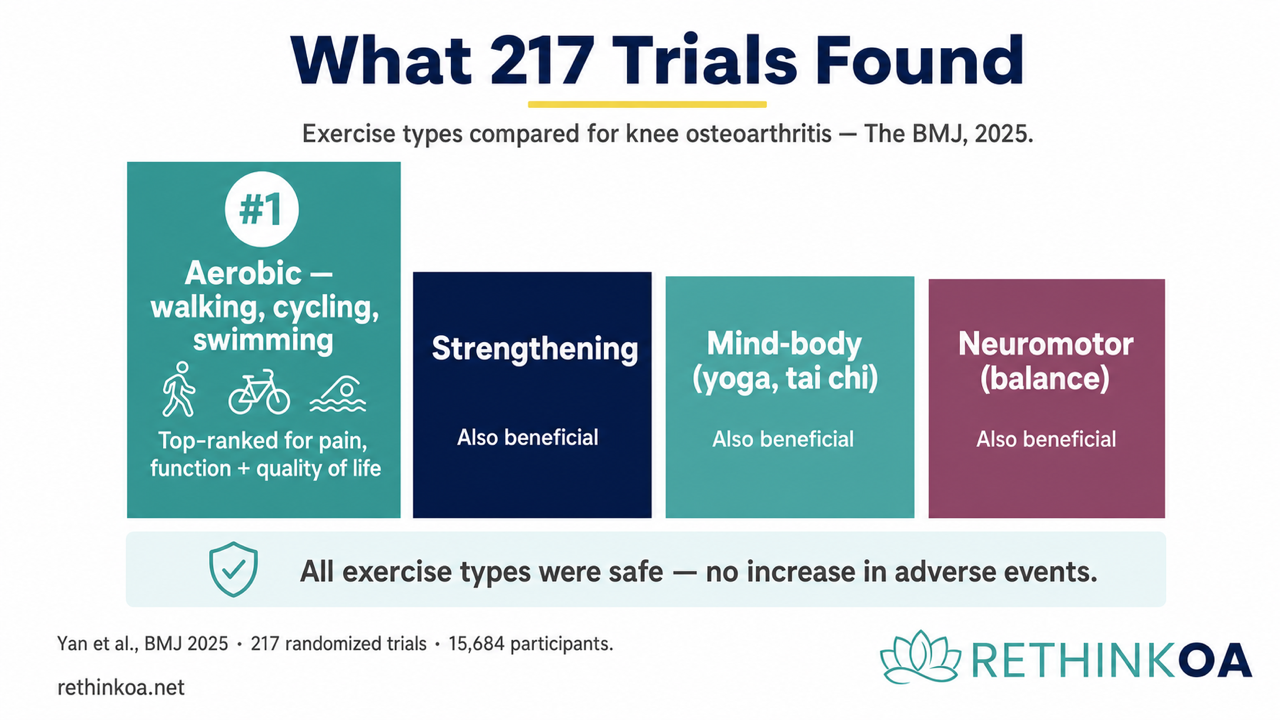
Across the board, aerobic exercise ranked as the most effective option. With moderate certainty, the evidence reduced pain in the short and mid-term, improved physical function at every time point measured, and improved walking ability and quality of life in the short and mid-term. Based on those results, the authors recommended aerobic exercise as a first-line intervention for managing knee osteoarthritis.
If that surprises you, you’re not alone. Many people assume the joint-friendliest exercise must be the gentlest, or that strength work is the only path. But walking, cycling, and swimming deliver a lot at once: rhythmic joint loading that cartilage responds well to, better fitness and sleep, weight support, and mood benefits—several of pain’s “volume knobs,” all turned down at once.
The Other Types Still Earned Their Place
This isn’t a verdict against your strength routine or yoga class—far from it. Mind-body exercise likely improved short-term function; neuromotor training likely improved short-term walking ability; strengthening and mixed programs improved function in the mid-term. The authors’ suggestion was about emphasis, not exclusivity: build the base with aerobic activity and use other forms alongside it—strength work, in particular, remains important for supporting the muscles around your knee.
And one finding deserves its own sentence: no exercise type showed an increased risk of adverse events compared with control groups. Across 217 trials, exercise was consistently safe for people with knee osteoarthritis—one more nail in the coffin of the “exercise wears out your joints” myth.
The Caveats (Because Honest Science Has Them)
The authors were upfront about limitations. Many comparisons between exercise types were indirect—inferred through the network rather than tested head-to-head. Long-term data beyond six months were thin for several outcomes. Trial quality varied, and smaller studies may have inflated early effect estimates. That’s why the evidence was graded “moderate” certainty rather than high.
So the fair summary isn’t “science proves walking is the best exercise.” It’s: the best available evidence suggests aerobic exercise is the strongest first choice for most people with knee osteoarthritis—and every studied type is safe and useful.
What This Means for Your Week
Here’s my honest translation, and it’s the caveat that outranks the rankings: the best exercise on a chart is worthless if you won’t do it, and the “second-best” exercise you genuinely enjoy will beat it every time. Research on rankings tells us where to start; research on behavior tells us that enjoyment and convenience are what keep people moving.
Practically speaking: if you’re unsure where to begin, start with aerobic exercise—a daily walk, a stationary bike, laps, or water walking at the pool. Start smaller than you think you need to and build gradually (the five-step approach walks you through it). Keep strength work in the rotation. And if tai chi or a yoga class is the thing you actually look forward to, that counts—enjoyment is a feature, not a cheat.
Final Thoughts
For years, people with knee osteoarthritis have been told to exercise without much guidance on what kind. This study offers the clearest comparison yet: aerobic exercise leads, everything studied helps, and nothing studied was harmful. If your knees have been waiting for permission to go for a walk, consider this 15,684 people’s worth of it.
And if what’s holding you back isn’t the what but the fear, that’s the part Rethink OA helps with—a short, clinically studied program for moving more and fearing pain less.
FAQ
What is the best exercise for knee osteoarthritis?
According to a 2025 network meta-analysis of 217 randomized trials published in The BMJ, aerobic exercise—such as walking, cycling, and swimming—ranked as the most effective for improving pain, function, walking ability, and quality of life in knee osteoarthritis. Strengthening, mind-body, neuromotor, and mixed programs also showed benefits and are useful alongside aerobic activity. Practically, the best exercise is an appropriately dosed one you enjoy enough to sustain.
Is walking good for knee osteoarthritis?
Yes—walking is one of the most studied and recommended activities for knee osteoarthritis. It provides the rhythmic joint loading that cartilage responds to, supports fitness, weight, sleep, and mood, and research shows it does not accelerate joint damage. Start with a distance that feels manageable and build gradually.
Is strength training still important if aerobic exercise is ranked best?
Yes. Strengthening improved function in the analysis and remains a core part of osteoarthritis care—strong muscles support and stabilize the joint. The study’s message was about where to start and what to emphasize, not about dropping strength work. Many people do best combining both.
How much aerobic exercise do I need with knee osteoarthritis?
There’s no single required dose. Trials commonly use two to three sessions per week, and shorter bouts spread through the day also count. If you’re returning after a break, start with 5–10 minutes at an easy pace and progress using the 24-hour rule: if symptoms settle within a day, the dose was appropriate.
Can exercise make knee osteoarthritis worse?
The evidence says no for appropriately dosed exercise: across 217 randomized trials, no exercise type was associated with increased adverse events, and separate research shows exercise doesn’t harm knee cartilage. Temporary soreness can happen—especially early on—but that’s adaptation, not damage.
About the Author
Melissa Boswell, PhD, is a bioengineer and digital health founder with nearly a decade of experience working in osteoarthritis, movement science, and human performance. She is the founder of Rethink OA, a clinically validated digital program developed from research conducted with collaborators at Stanford University and published in npj Digital Medicine. Her work focuses on helping people better understand pain, movement, and behavior change in osteoarthritis.

References
- Yan L, Li D, Xing D, et al. Comparative efficacy and safety of exercise modalities in knee osteoarthritis: systematic review and network meta-analysis. BMJ. 2025;391:e085242. https://doi.org/10.1136/bmj-2025-085242
- Bricca A, et al. Impact of exercise on articular cartilage in people at risk of, or with established, knee osteoarthritis: a systematic review of randomised controlled trials. Br J Sports Med. 2019;53(15):940-947. https://bjsm.bmj.com/content/53/15/940
- Kolasinski SL, et al. 2019 American College of Rheumatology/Arthritis Foundation Guideline for the Management of Osteoarthritis of the Hand, Hip, and Knee. Arthritis Care Res. 2020;72(2):149-162. https://pubmed.ncbi.nlm.nih.gov/31908163/
- World Health Organization. Physical activity fact sheet. https://www.who.int/news-room/fact-sheets/detail/physical-activity
- Boswell MA, et al. Mindset and physical activity intervention for adults with knee osteoarthritis. npj Digital Medicine. 2024. https://www.nature.com/articles/s41746-024-01281-8
Move More. Fear Pain Less.
Learn how to reduce pain, stay active, and support your joints—starting today.