
Can You Improve Osteoarthritis Without Surgery?
Jul 13, 2026
When people are diagnosed with knee osteoarthritis, many hear some version of the same message: “You’ll probably need a knee replacement eventually.” Maybe a doctor said it. Maybe a family member who had surgery said it. Maybe it’s just the story we’ve all absorbed—that osteoarthritis is a one-way road, and surgery is the destination.
But here’s what surprises many people: for a large number of individuals with knee osteoarthritis, meaningful improvement is possible without surgery. That’s not wishful thinking. It’s what decades of research—including studies of people who were already eligible for knee replacement—consistently suggests. Let me share one of my favorite examples.
The Study That Challenged the “Inevitable Surgery” Story
In a landmark trial published in the New England Journal of Medicine, researchers in Denmark did something bold. They enrolled 100 people with moderate-to-severe knee osteoarthritis—all considered eligible for total knee replacement—and randomly assigned them to one of two paths: knee replacement surgery followed by a nonsurgical program, or the nonsurgical program alone. The program consisted of supervised exercise, education, dietary advice, insoles, and pain medication if needed.
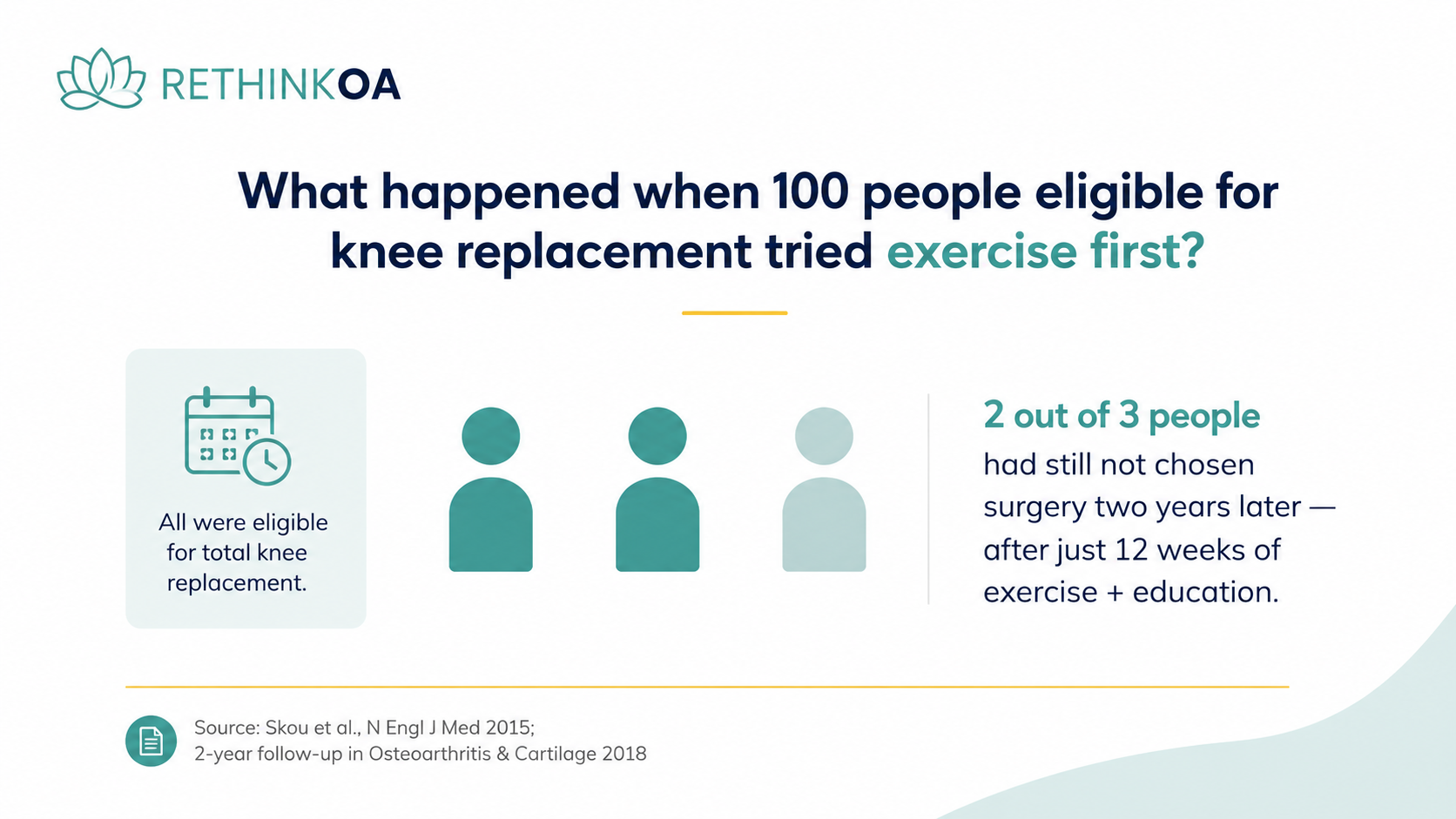
The surgery group improved more on average, and that’s important to acknowledge—knee replacement can be a very effective treatment for the right person at the right time. But the nonsurgical group improved too, meaningfully. And here is the part that often gets missed: at the two-year follow-up, about two out of three people in the nonsurgical group still had not needed or chosen surgery.
Remember, these were people already considered candidates for knee replacement. With twelve weeks of exercise and education, most of them improved enough that surgery no longer felt necessary—at least not yet. For many, “inevitable” turned out to be optional.
Why Exercise and Education Are the First-Line Treatment (Not Surgery)
This isn’t one quirky study. Every major clinical guideline—including those from the American College of Rheumatology and OARSI, the leading international osteoarthritis research society—recommends exercise, education, and weight management as the core, first-line treatments for knee osteoarthritis. Surgery is positioned as an option to consider when these approaches have been genuinely tried, and symptoms remain severe.
The evidence keeps growing. A 2025 analysis in The BMJ pooled data from 217 randomized trials involving more than 15,000 participants and found that exercise—especially aerobic activity such as walking, cycling, and swimming—improved pain, function, and quality of life, with no increase in adverse events compared with control groups. In Denmark’s nationwide GLA:D program, which delivers just eight weeks of education and supervised exercise, participants with knee osteoarthritis report average pain reductions of roughly 25%—along with less use of pain medication and fewer sick days.
If you’ve been told that exercise will “wear out” your joint faster, you’re not alone—it’s one of the most common and understandable worries I hear. The research suggests the opposite: appropriately dosed movement supports joint health. I wrote more about that in Does Exercise Make Osteoarthritis Worse?
What Surgery Can and Can’t Do
I want to be clear: this is not an anti-surgery article. For people with severe symptoms who haven’t improved with well-delivered nonsurgical care, knee replacement can be life-changing, and outcomes are good for most people.
But surgery is not a guaranteed fix. Research suggests that roughly one in five people report ongoing pain or dissatisfaction after total knee replacement. Surgery also can’t rebuild muscle strength, restore fitness, improve sleep, or change how the nervous system processes pain—factors that all influence how a knee feels, before and after an operation. That’s part of why the strength, habits, and confidence you build now still pay off even if you eventually choose surgery. Researchers sometimes call this “prehab,” and it’s associated with better recoveries.
One more thing worth knowing: for most people, there’s no medical deadline. Osteoarthritis generally progresses slowly, and choosing to try nonsurgical care first doesn’t typically “ruin” a future surgery. That means you have time to experiment, build, and see how much you can improve. (Always discuss your individual situation with your care team—this is general education, not personal medical advice.)
What “Improving Without Surgery” Actually Looks Like
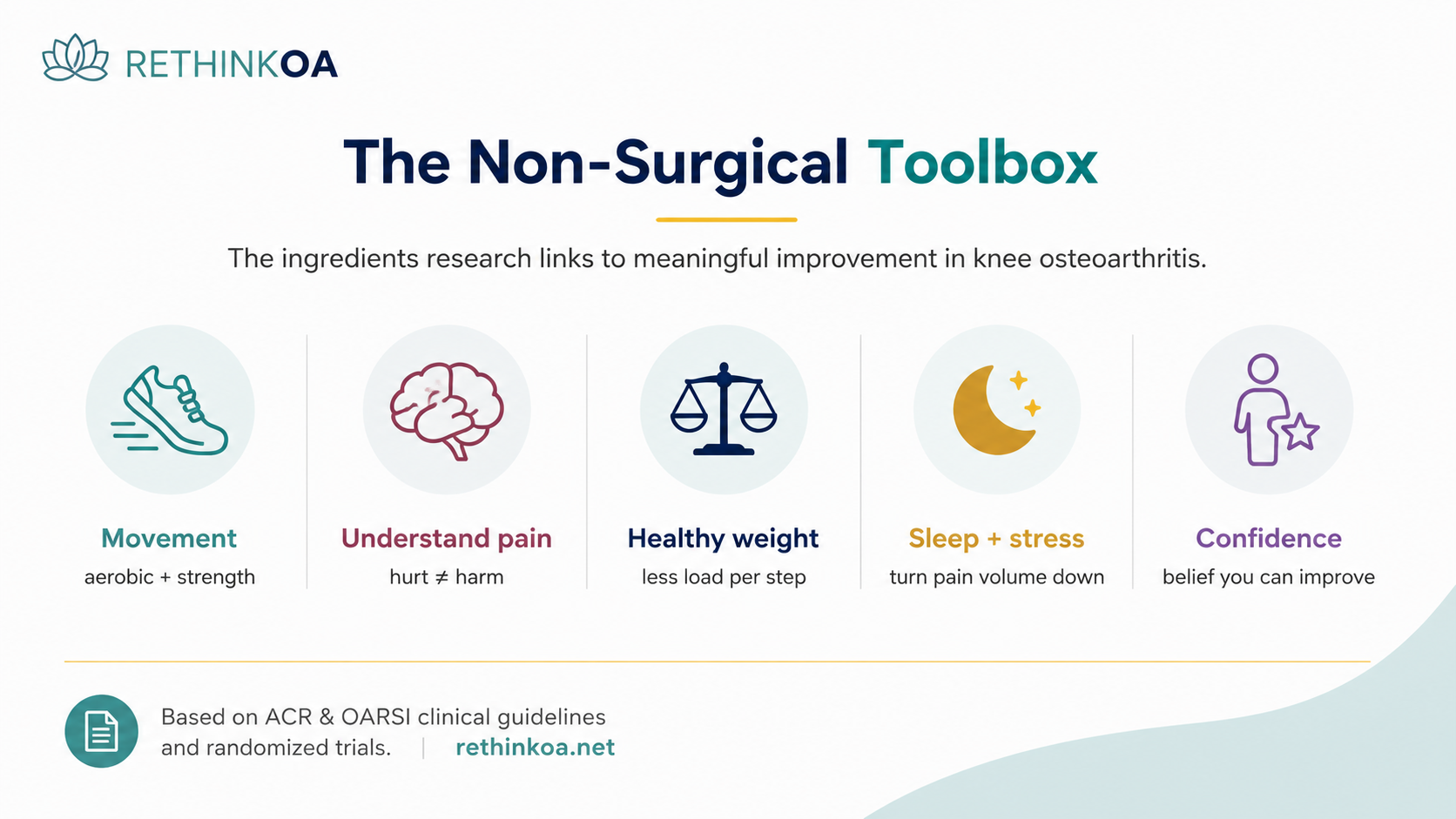
So what were those study participants actually doing? Nothing exotic. The consistent ingredients across the research are:
- Regular, appropriately dosed movement — aerobic activity plus strengthening the muscles that support your knee
- Understanding your pain — learning that pain is influenced by much more than joint structure, which is associated with less fear and more activity
- Weight management, where relevant — each pound lost removes roughly three to four pounds of load from the knee with every step
- Sleep, stress, and overall health — all of which can turn the “volume” of pain up or down
- Confidence — the belief that you can influence your symptoms, which may be one of the most important factors in osteoarthritis
That last ingredient matters more than most people realize. In our own clinical study of the Rethink OA program, published in npj Digital Medicine, participants reported a 44% reduction in their perceived need for surgery—along with increased physical activity and reduced fear of movement—after a program focused entirely on how they think about osteoarthritis, pain, and exercise. No injections. No scalpels. A shift in understanding.
How to Think About Your Own Decision
If you’re weighing your options, a few questions worth discussing with your clinician: Have I genuinely tried a structured exercise and education program—not just “go home and exercise,” but a real, progressive plan for at least three months? Do I understand what’s actually driving my pain? Am I choosing surgery because my function and quality of life demand it, or because I believe nothing else can work?
That last belief is the one I’d most like to challenge. Because the research suggests it simply isn’t true for many people. Surgery will still be there if you need it. But you may be able to improve more than you’ve been led to expect—starting with how you understand your pain and what you believe your body is capable of.
If you’d like a place to start, Rethink OA is a short, evidence-based program developed from research at Stanford University that helps you understand your pain and rebuild confidence with movement—in under two hours, from home.
FAQ
Can knee osteoarthritis improve without surgery?
Yes, for many people. Research suggests that exercise, education, and weight management can meaningfully improve pain and function in knee osteoarthritis. In a randomized trial of people who were all eligible for knee replacement, about two out of three who received a structured nonsurgical program had still not undergone surgery two years later. Individual results vary, and improvement doesn’t mean the osteoarthritis disappears—it means symptoms and function can get meaningfully better.
What are the alternatives to knee replacement surgery?
Clinical guidelines recommend starting with structured exercise (aerobic and strengthening), osteoarthritis education, and weight management where relevant. Other supports include physical therapy, appropriate pain relief strategies, addressing sleep and stress, and building self-efficacy—confidence in your ability to manage symptoms. These aren’t “lesser” options; they are the recommended first-line treatments in every major guideline.
Does delaying knee replacement make things worse?
For most people, no. Osteoarthritis typically progresses slowly, and trying guideline-recommended nonsurgical care first is the standard, recommended pathway. In fact, the strength, fitness, and confidence you build often improve outcomes if you do eventually choose surgery. Your own timeline is something to discuss with your care team, since individual situations differ.
Is “bone-on-bone” always a reason for surgery?
No. The severity of osteoarthritis on an X-ray correlates surprisingly poorly with how much pain a person feels or how well they function. Many people with significant changes on imaging remain active with manageable symptoms, while others with mild changes have severe pain. Imaging is one piece of information—not a verdict. Treatment decisions are best based on your symptoms, function, and goals rather than the picture alone.
When is knee replacement the right choice?
Knee replacement is generally considered when symptoms remain severe and significantly limit daily life despite a genuine trial of nonsurgical care—typically several months of structured exercise, education, and other guideline-recommended treatments. For people in that situation, surgery can be very effective. The key is that it’s a considered choice made with your clinician, not an automatic destination.
How long does it take to see improvement without surgery?
Many structured programs run 8 to 12 weeks, and research suggests that’s often enough time to see meaningful changes in pain and function. Some people notice improvements in confidence and comfort with movement even sooner. Consistency matters more than intensity—small, regular doses of movement tend to outperform occasional big efforts.
About the Author
Melissa Boswell, PhD, is a bioengineer and digital health founder with nearly a decade of experience working in osteoarthritis, movement science, and human performance. She is the founder of Rethink OA, a clinically validated digital program developed from research conducted with collaborators at Stanford University and published in npj Digital Medicine. Her work focuses on helping people better understand pain, movement, and behavior change in osteoarthritis.

References
- Skou ST, Roos EM, Laursen MB, et al. A Randomized, Controlled Trial of Total Knee Replacement. N Engl J Med. 2015;373(17):1597-1606. https://www.nejm.org/doi/full/10.1056/NEJMoa1505467
- Skou ST, Roos EM, Laursen MB, et al. Total knee replacement and non-surgical treatment of knee osteoarthritis: 2-year outcome from two parallel randomized controlled trials. Osteoarthritis Cartilage. 2018;26(9):1170-1180. https://pubmed.ncbi.nlm.nih.gov/29723634/
- Kolasinski SL, Neogi T, Hochberg MC, et al. 2019 American College of Rheumatology/Arthritis Foundation Guideline for the Management of Osteoarthritis of the Hand, Hip, and Knee. Arthritis Care Res. 2020;72(2):149-162. https://pubmed.ncbi.nlm.nih.gov/31908163/
- Bannuru RR, Osani MC, Vaysbrot EE, et al. OARSI guidelines for the non-surgical management of knee, hip, and polyarticular osteoarthritis. Osteoarthritis Cartilage. 2019;27(11):1578-1589. https://pubmed.ncbi.nlm.nih.gov/31278997/
- Yan L, Li D, Xing D, et al. Comparative efficacy and safety of exercise modalities in knee osteoarthritis: systematic review and network meta-analysis. BMJ. 2025;391:e085242. https://doi.org/10.1136/bmj-2025-085242
- Skou ST, Roos EM. Good Life with osteoArthritis in Denmark (GLA:D): evidence-based education and supervised neuromuscular exercise delivered by certified physiotherapists nationwide. BMC Musculoskelet Disord. 2017;18(1):72. https://pubmed.ncbi.nlm.nih.gov/28173795/
- Beswick AD, Wylde V, Gooberman-Hill R, et al. What proportion of patients report long-term pain after total hip or knee replacement for osteoarthritis? A systematic review of prospective studies in unselected patients. BMJ Open. 2012;2(1):e000435. https://bmjopen.bmj.com/content/2/1/e000435
- Boswell MA, et al. Mindset and physical activity intervention for adults with knee osteoarthritis. npj Digital Medicine. 2024. https://www.nature.com/articles/s41746-024-01281-8
Move More. Fear Pain Less.
Learn how to reduce pain, stay active, and support your joints—starting today.