
What Most People Don't Understand About Chronic Pain and Osteoarthritis
Sep 28, 2026
If you’ve lived with knee osteoarthritis for a while, you’ve probably noticed that your pain doesn’t follow the rules you were taught. It shows up on rest days and disappears mid-hike. It roars after a stressful week and quiets on vacation. It ignores the weather forecast one month and follows it the next. If pain were a simple damage meter, none of that would make sense.
That’s because the “damage meter” model of pain—the one most of us absorbed growing up—is decades out of date. Modern pain science tells a different, more hopeful story, and understanding it isn’t just interesting trivia: studies suggest that learning how pain actually works can itself reduce fear and improve how people move and live. Here are five truths about chronic pain that most people were never told.
1. Pain Is a Protector, Not a Damage Meter
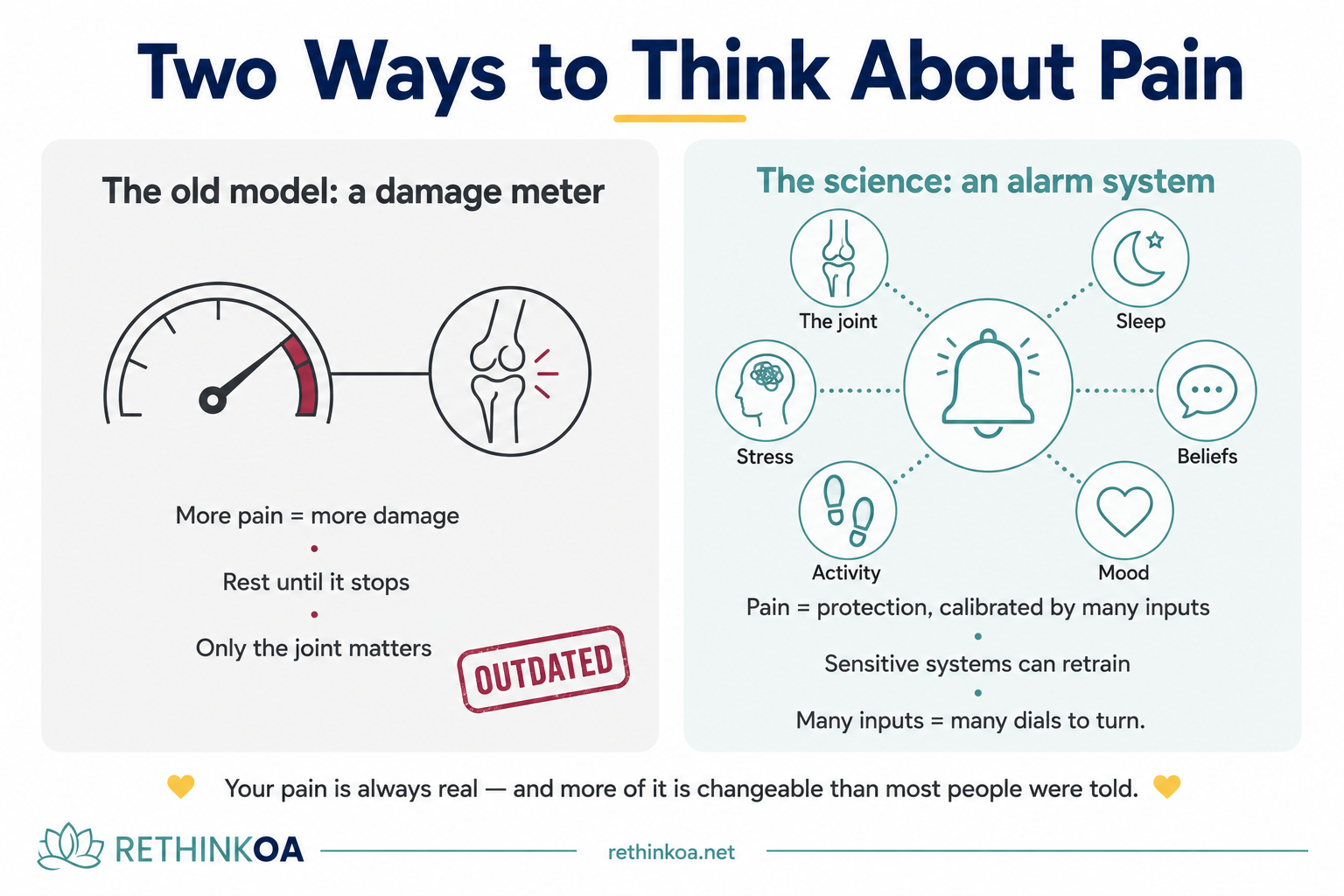
The international scientific definition of pain describes it as an unpleasant experience associated with—or resembling that associated with—tissue damage. That careful wording exists because pain and damage are not the same thing. Pain is produced by your brain and nervous system as a protective output: an alarm system whose job is to get you to act, based on its best estimate of threat.
Like any alarm system, it can be calibrated loosely or tightly. It weighs joint signals, yes—but also your stress level, your sleep, your memories of past pain, and what you believe is happening inside your knee. That’s why the X-ray so often disagrees with the experience: the alarm isn’t wired to the picture. It’s wired to the perceived threat.
2. Long-Lasting Pain Usually Means a Sensitive System, Not Worsening Damage
When pain persists for months or years, something important changes: the nervous system itself adapts. Researchers call it central sensitization—the alarm system becomes more easily triggered and amplifies signals, like a smoke detector recalibrated to go off at toast. Studies in knee osteoarthritis consistently find evidence of this sensitization in a substantial share of people.
This is one of the most misunderstood—and most liberating—facts in all of pain science: more pain over time does not necessarily mean more damage over time. Often, it means a more protective system. And as we covered in our post on flares, the things that turn that sensitivity up—poor sleep, stress, inactivity, fear—are things that can change.
3. “Influenced by the Brain” Does Not Mean “Imaginary”
This one matters enormously, so let me be direct: when scientists say pain is produced by the brain and shaped by thoughts, sleep, and stress, they are not saying your pain is made up, exaggerated, or your fault. All pain—every kind, from a stubbed toe to surgery—is produced by the brain. That’s simply how pain works. It is always real, always physical, and always worth taking seriously.
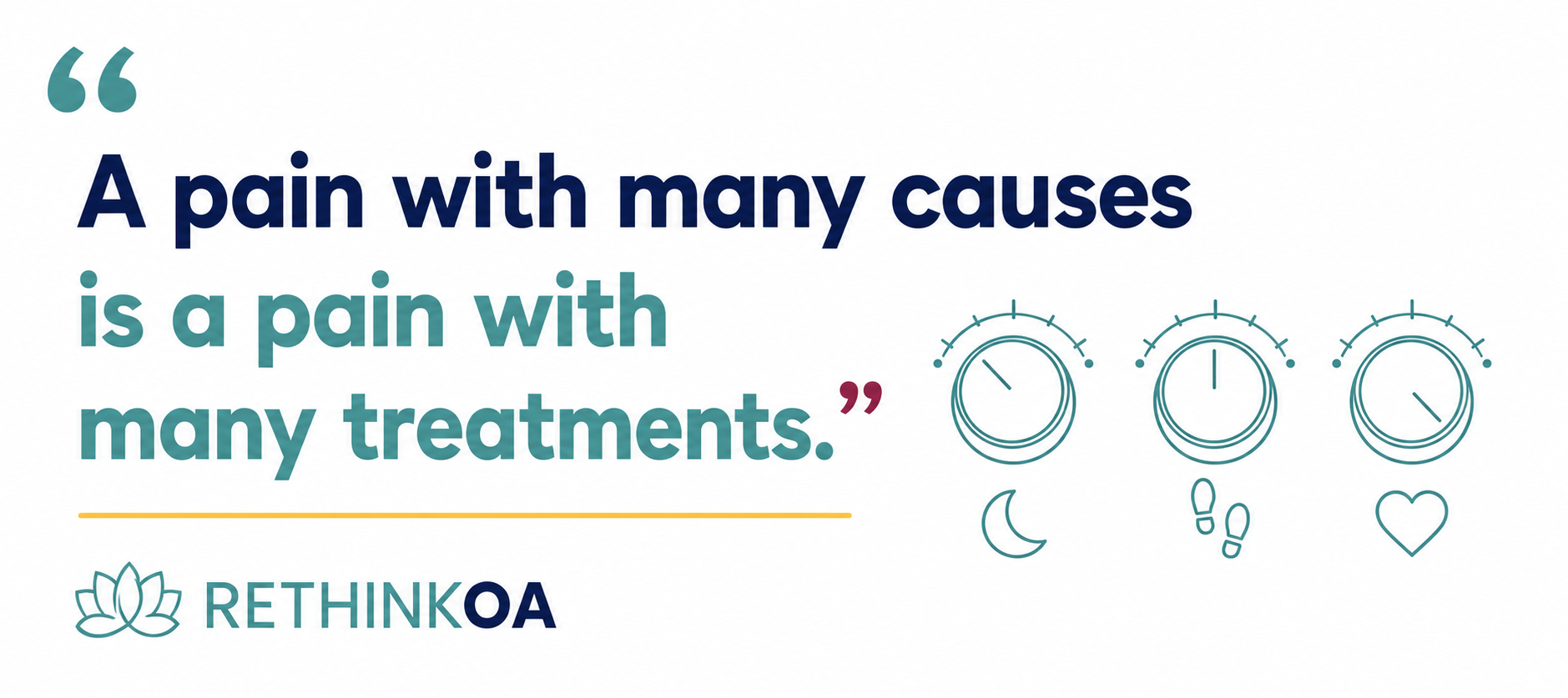
What the science adds is good news: because the alarm system has many inputs, it has many dials. Sleep is a dial—research shows poor sleep often precedes and amplifies pain. Stress is a dial. Understanding is a dial, which is why pain science education itself has been found to reduce fear and improve outcomes. A pain with many causes has many treatments.
4. Hurt and Harm Are Different—and That Changes What’s “Safe”
In acute injury, pain roughly tracks harm: it hurts because something just got damaged, and rest helps it heal. Chronic pain breaks that link. With a sensitized system, everyday movement can hurt without causing any damage at all—the alarm sounds at toast, not fire. Treating every hurt as harm leads straight into the trap we’ve written about before: avoidance, deconditioning, and a system that grows even more sensitive.
The evidence-based alternative isn’t pushing through sharp pain—it’s graded activity: starting where your body is, nudging the edges of discomfort, and letting each successful exposure teach your alarm system that movement is safe. Appropriately dosed exercise is safe for arthritic joints, doesn’t damage cartilage, and remains the first-line treatment in every major guideline.
5. Sensitive Systems Can Become Less Sensitive
Here’s the truth that ties it all together: the same adaptability that lets your nervous system become more sensitive works in reverse. Alarm systems can be retrained. Research suggests sensitivity can decrease through graded movement and exercise, better sleep, stress management, pain science education, and rebuilding confidence—each one a signal of safety that, repeated over time, turns the volume down. In our own randomized trial, a two-hour program that changed how people understood their osteoarthritis reduced fear of movement and increased activity—the exact inputs a recalibrating alarm system needs.
Chronic pain is not a life sentence handed down by your cartilage. It’s an ongoing conversation between your joint, your brain, and your life—and you have more say in that conversation than most people were ever told.
Final Thoughts
Most people carry a model of pain that quietly steals their options: pain equals damage, damage equals decline, decline equals surgery or surrender. Modern pain science replaces it with something more accurate and more workable: pain is protection; protection can be miscalibrated; and calibration responds to sleep, movement, stress, understanding, and confidence. Your pain is real. And more of it than you think is changeable.
If you want the guided version of this understanding—the one we tested in a clinical trial—that’s Rethink OA: under two hours, from home, built on exactly this science.
FAQ
Is osteoarthritis pain considered chronic pain?
Often, yes. Chronic pain is generally defined as pain persisting beyond three months, and many people with osteoarthritis experience symptoms well beyond that. Importantly, in long-lasting pain the nervous system itself often becomes more sensitive, which means the pain is influenced by more than joint structure—and can improve through more routes than joint-focused treatment alone.
Does chronic pain mean my joint damage is getting worse?
Not necessarily. Research shows pain severity correlates poorly with imaging findings, and persistent pain frequently reflects a sensitized nervous system rather than progressing damage. Osteoarthritis structural changes typically evolve slowly over years, while pain can fluctuate day-to-day with sleep, stress, activity, and mood—a pattern that points to sensitivity, not damage.
Is my pain all in my head?
No. All pain—acute or chronic—is produced by the brain and nervous system; that’s true of a fresh injury, too, and it makes no pain imaginary. Your pain is real and physical. What modern pain science adds is that the systems that produce pain have many inputs—sleep, stress, beliefs, activity—which means there are many legitimate ways to influence them.
What is central sensitization in osteoarthritis?
Central sensitization is a state in which the nervous system amplifies pain signals—a lower threshold and louder response, like an alarm set too sensitive. Systematic reviews have found evidence of pain sensitization in a substantial portion of people with knee osteoarthritis. It helps explain pain that spreads, lingers, or seems disproportionate to imaging—and it can improve, since the nervous system remains changeable in both directions.
Can chronic osteoarthritis pain improve?
For many people, yes. Research supports several routes: graded, appropriately dosed exercise; improved sleep; stress management; pain science education; and rebuilding confidence with movement. None is an overnight cure, and improvement doesn’t mean zero pain—but the combination can meaningfully change how much pain interferes with life. Your care team can help tailor these to your situation.
About the Author
Melissa Boswell, PhD, is a bioengineer and digital health founder with nearly a decade of experience working in osteoarthritis, movement science, and human performance. She is the founder of Rethink OA, a clinically validated digital program developed from research conducted with collaborators at Stanford University and published in npj Digital Medicine. Her work focuses on helping people better understand pain, movement, and behavior change in osteoarthritis.

References
- Raja SN, et al. The revised International Association for the Study of Pain definition of pain: concepts, challenges, and compromises. Pain. 2020;161(9):1976-1982. https://doi.org/10.1097/j.pain.0000000000001939
- Woolf CJ. Central sensitization: implications for the diagnosis and treatment of pain. Pain. 2011;152(3 Suppl):S2-S15. https://pubmed.ncbi.nlm.nih.gov/20961685/
- Fingleton C, et al. Pain sensitization in people with knee osteoarthritis: a systematic review and meta-analysis. Osteoarthritis Cartilage. 2015;23(7):1043-1056. https://doi.org/10.1016/j.joca.2015.02.163
- Moseley GL, Butler DS. Fifteen years of explaining pain: the past, present, and future. J Pain. 2015;16(9):807-813. https://doi.org/10.1016/j.jpain.2015.05.005
- Finan PH, Goodin BR, Smith MT. The association of sleep and pain: an update and a path forward. J Pain. 2013;14(12):1539-1552. https://doi.org/10.1016/j.jpain.2013.08.007
- Kolasinski SL, et al. 2019 American College of Rheumatology/Arthritis Foundation Guideline for the Management of Osteoarthritis of the Hand, Hip, and Knee. Arthritis Care Res. 2020;72(2):149-162. https://pubmed.ncbi.nlm.nih.gov/31908163/
- Boswell MA, et al. A randomized clinical trial testing digital mindset intervention for knee osteoarthritis pain and activity improvement. npj Digital Medicine. 2024. https://www.nature.com/articles/s41746-024-01281-8
Move More. Fear Pain Less.
Learn how to reduce pain, stay active, and support your joints—starting today.