
Why Pain Flares Don't Always Mean You Damaged Your Joint
Jul 27, 2026
It usually goes something like this: you have a good stretch—a few weeks where your knee feels manageable, you’re moving more, life feels bigger. Then, seemingly out of nowhere, your knee lights up. It’s stiffer, angrier, and more painful than it’s been in months. And your mind goes straight to the scariest explanation: I’ve damaged something. I’ve made it worse.
If that’s you, here is the single most useful thing modern pain science has to offer: a flare in osteoarthritis pain does not mean your joint suddenly got worse. Pain and joint damage are related—but far more loosely than most people assume. Understanding why can change how you respond to flares, and how quickly you get through them.
What a Flare Actually Is
A pain flare is a temporary increase in symptoms—pain, stiffness, sometimes swelling—that rises above your usual baseline and then, importantly, settles back down. Flares are a normal, expected part of living with osteoarthritis. Nearly everyone with knee osteoarthritis experiences them, and they typically last hours to days, not months.
The key word is temporary. Osteoarthritis itself changes slowly—over years. Cartilage doesn’t wear away in a weekend. So when pain doubles overnight, the joint structure almost certainly didn’t change overnight. Something else is turning up the volume. (For the full picture of what drives osteoarthritis pain, see What Actually Causes Osteoarthritis Pain?)
Pain and Joint Damage Are Surprisingly Loosely Connected
This is one of the most replicated findings in osteoarthritis research: the severity of osteoarthritis on an X-ray correlates poorly with how much pain a person feels. A systematic review in BMC Musculoskeletal Disorders found that among people with knee osteoarthritis visible on X-ray, anywhere from 15% to 81% reported pain—an enormous range that simply shouldn’t exist if damage alone determined pain. Some people with severe-looking joints feel little; some with mild changes hurt a lot.
We explored a related study in our research spotlight on imaging and pain. The takeaway bears repeating: your X-ray is not a pain forecast. So if pain can vary this much between people with identical joints, it makes sense that pain can vary this much within you from week to week—without your joint changing at all.
Your Nervous System Has a Volume Knob
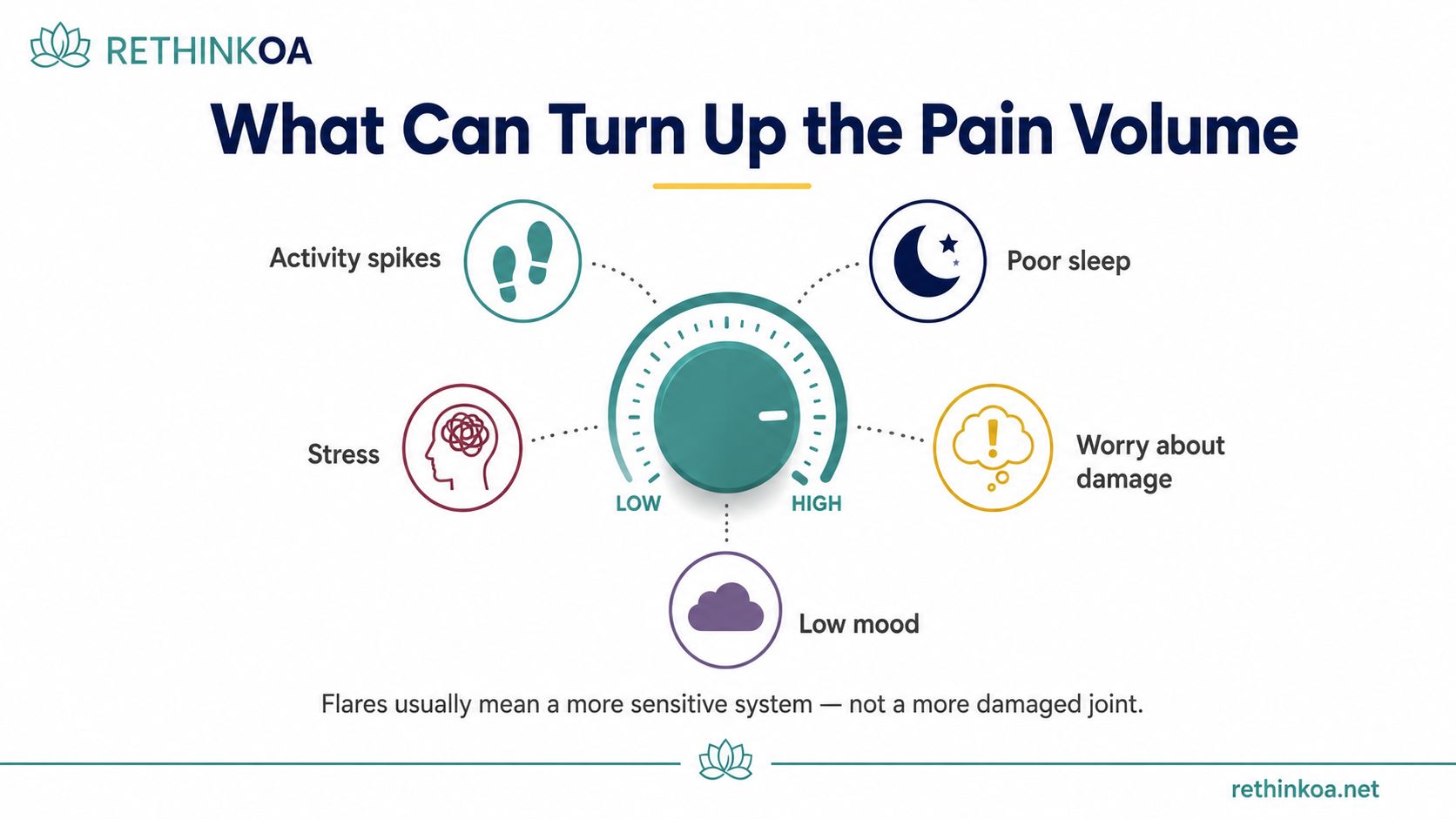
Here’s the mechanism behind many flares. Pain isn’t a direct readout of tissue damage; it’s produced by your nervous system based on many inputs—including signals from the joint, but also stress, sleep, mood, memories, and expectations. In many people with knee osteoarthritis, the nervous system becomes sensitized: it amplifies signals, like a radio with the volume turned up. A systematic review in Osteoarthritis and Cartilage found consistent evidence of this pain sensitization in knee osteoarthritis.
When the volume is up, the same joint produces more pain. And research points to reliable volume-turners: poor sleep is strongly linked to next-day pain sensitivity (a review in The Journal of Pain found sleep problems often precede pain increases), and stress and anxiety prime the nervous system to be more protective. Add an unusual spike in activity—a long day of yard work, travel, extra stairs—and you have the classic recipe for a flare. Notice what’s missing from that recipe: new structural damage.
What to Do When a Flare Hits
First, reframe it. A flare is your protective system being extra cautious—not an alarm that you’ve broken something. That reframe isn’t just comforting; it changes behavior. People who interpret flares as damage tend to stop moving entirely, and extended rest often leads to more stiffness, weaker muscles, and a more sensitive system. (More on that trap in an upcoming post on why “rest until it stops hurting” can backfire.)
Instead, think relative rest: temporarily reduce—don’t eliminate—activity. Gentle movement, shorter walks, easy range-of-motion work. Support the systems that calm the volume knob: prioritize sleep, manage stress, do things you enjoy. Ice or heat if they feel good. Then, as symptoms settle—usually within days—gradually return to your normal activity using the step-by-step approach from last week’s post.
And be kind to yourself. A flare doesn’t mean your management plan failed, and it doesn’t erase your progress. It’s weather, not climate.
When to Check In With a Clinician
Flares are normal, but some symptoms deserve a professional look: a hot, red, significantly swollen joint; pain following a specific injury or fall; fever; pain that is severe and unrelenting; or a flare that doesn’t begin settling after a week or two. None of these automatically mean something serious—but they’re worth evaluating. This article is general education, not a substitute for individual medical advice.

The Bigger Picture
Flares feel like evidence that your joint is failing. The research suggests they’re usually evidence of something far less scary: a protective nervous system reacting to sleep, stress, and spikes in activity. That distinction matters, because it hands you back some control. You can’t always prevent a flare—but you can respond in ways that calm the system instead of alarming it further, and you can watch it pass, as it almost always does.
Learning to understand what your pain is (and isn’t) telling you is one of the core skills we teach in Rethink OA—in under two hours, from home.
FAQ
Does an osteoarthritis flare mean my joint is getting worse?
Usually not. Osteoarthritis changes joint structure slowly—over years—while flares develop over hours to days and then settle. Research shows pain severity correlates poorly with joint changes on imaging. Most flares reflect a temporarily more sensitive and protective nervous system, often triggered by activity spikes, poor sleep, or stress, rather than new damage.
How long does an osteoarthritis pain flare last?
Most flares last from a few hours to several days. If a flare is severe, follows an injury, comes with significant swelling, redness, or fever, or shows no sign of settling after a week or two, it’s worth checking in with a clinician.
What triggers osteoarthritis flare-ups?
Common triggers include unusual spikes in activity (a long day on your feet, travel, extra stairs), poor sleep, stress, and low mood. Research suggests these factors increase the nervous system’s sensitivity, amplifying pain from the same joint. Weather changes are commonly reported too, though the evidence there is mixed.
Should I stop exercising during a flare?
Complete rest usually isn’t the best strategy. Most people do better with “relative rest”: temporarily reducing the amount or intensity of activity while staying gently in motion, then building back up as symptoms settle. Extended rest can increase stiffness and weakness and make the return to activity harder.
Can stress and sleep really affect knee pain?
Yes. Research suggests poor sleep is linked to increased pain sensitivity—and sleep problems often precede pain increases, not just follow them. Stress similarly primes the nervous system to be more protective. This is part of why pain can flare even when nothing has changed in the joint itself.
About the Author
Melissa Boswell, PhD, is a bioengineer and digital health founder with nearly a decade of experience working in osteoarthritis, movement science, and human performance. She is the founder of Rethink OA, a clinically validated digital program developed from research conducted with collaborators at Stanford University and published in npj Digital Medicine. Her work focuses on helping people better understand pain, movement, and behavior change in osteoarthritis.

References
- Bedson J, Croft PR. The discordance between clinical and radiographic knee osteoarthritis: a systematic search and summary of the literature. BMC Musculoskelet Disord. 2008;9:116. https://bmcmusculoskeletdisord.biomedcentral.com/articles/10.1186/1471-2474-9-116
- Fingleton C, Smart K, Moloney N, Fullen BM, Doody C. Pain sensitization in people with knee osteoarthritis: a systematic review and meta-analysis. Osteoarthritis Cartilage. 2015;23(7):1043-1056. https://doi.org/10.1016/j.joca.2015.02.163
- Finan PH, Goodin BR, Smith MT. The association of sleep and pain: an update and a path forward. J Pain. 2013;14(12):1539-1552. https://doi.org/10.1016/j.jpain.2013.08.007
- National Institute of Arthritis and Musculoskeletal and Skin Diseases (NIAMS). Osteoarthritis. https://www.niams.nih.gov/health-topics/osteoarthritis
- Boswell MA, et al. Mindset and physical activity intervention for adults with knee osteoarthritis. npj Digital Medicine. 2024. https://www.nature.com/articles/s41746-024-01281-8
Move More. Fear Pain Less.
Learn how to reduce pain, stay active, and support your joints—starting today.