
Why "Rest Until It Stops Hurting" Can Backfire With Osteoarthritis
Aug 10, 2026
It sounds like the most sensible advice in the world: if it hurts, rest until it doesn’t. That’s how we treat a sprained ankle or a pulled muscle, and for short-term injuries, rest has its place. So when knee osteoarthritis flares, resting until the pain fully disappears feels like the responsible thing to do. Careful. Smart.
But osteoarthritis isn’t a sprained ankle. It’s a long-term condition where pain doesn’t reliably signal damage—and where waiting for zero pain before moving again can mean waiting forever. Research suggests that prolonged rest often makes the situation worse, not better. Here’s why the wait-until-it-stops-hurting strategy backfires, and what actually helps.
The Logic Trap: Why Resting Feels Right
The rest instinct stems from a reasonable-sounding belief: pain signals damage, so moving during pain must cause more damage. But as we covered in last month’s post on pain flares, osteoarthritis pain is influenced by far more than joint structure—sleep, stress, activity patterns, and a nervous system that can amplify signals like a radio with the volume turned up. Hurt and harm are not the same thing.
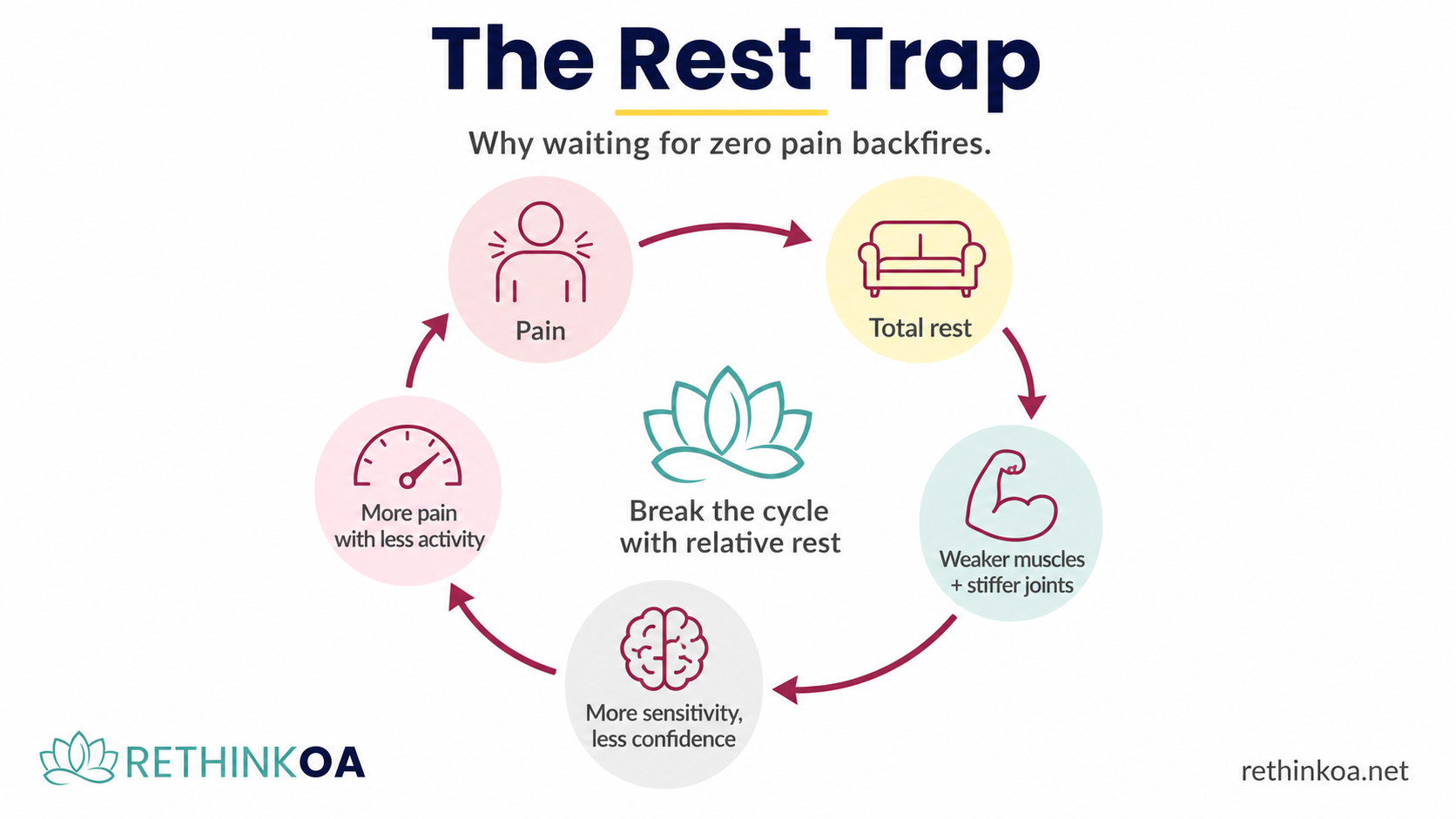
That distinction changes the math on rest. If pain were purely a damage meter, resting to zero would make sense. But if pain is partly a sensitivity meter, then total rest doesn’t just fail to fix it—it can slowly turn the sensitivity up.
What Actually Happens When You Stop Moving
Bodies adapt to what we ask of them—in both directions. Ask more, and muscles, tendons, and bones get stronger. Ask nothing, and they adapt to nothing. Within weeks of significantly reduced activity, muscles measurably weaken, and the muscles around your knee are its primary shock absorbers and stabilizers. Weaker muscles mean less support for the joint, which often leads to more pain during the same activities.
Joints themselves also dislike stillness. Movement circulates synovial fluid—the joint’s lubricant and nutrient delivery system—which is part of why the stiffest moments of the day come after sitting or sleeping, and why joints often feel better once you get going. Meanwhile, extended rest tends to worsen sleep, lower mood, and shrink your world—all factors that research links to increased pain sensitivity. Rest quietly works against you on every front at once.
Your Cartilage Doesn’t Want a Vacation Either
Here’s the part that surprises people most: cartilage has no blood supply of its own. It gets its nutrition from joint fluid, and the pump that moves that fluid in and out of cartilage is load—the gentle squeeze and release of walking, cycling, and moving through your day. Loading isn’t the enemy of cartilage. It’s the delivery system.
The evidence backs this up. A systematic review in the British Journal of Sports Medicine found that knee-joint loading exercise did not harm cartilage in people with, or at risk of, knee osteoarthritis—and found signals of benefit. It’s why I like reframing “wear and tear” as “wear and repair”: your body needs regular use to maintain itself. And it’s why every major guideline recommends exercise—not rest—as the first-line treatment for knee osteoarthritis. (More on that evidence in Does Exercise Make Osteoarthritis Worse?)
The Deeper Cost: Rest Feeds the Fear Cycle
There’s one more cost of the wait-for-zero-pain strategy, and it might be the biggest. Every week of avoidance quietly teaches your brain a lesson: movement is dangerous, and my body can’t handle it. Confidence shrinks. The list of “things I don’t do anymore” grows. And when you finally do move, a deconditioned body plus a hypervigilant nervous system practically guarantees it won’t feel good, which seems to confirm the fear, and earns the couch another month.
This is the fear-of-movement cycle, and total rest is its fuel. The way out isn’t courage in one heroic leap—it’s small, unmistakable wins that retrain both your muscles and your brain’s threat assessment, step by step.
What to Do Instead: Relative Rest
When symptoms are up, the evidence-based move is relative rest: turn the dial down, don’t switch it off. Swap the long walk for a short one. Trade impact for cycling or water exercise. Keep gentle range-of-motion movement in the mix daily. Then use the 24-hour rule to guide your return: if symptoms settle within a day, that dose was fine—repeat it or build slightly.
Some discomfort along the way is normal and expected. The goal was never zero pain before moving. The goal is moving in doses your body can adapt to—because adaptation, not avoidance, is how things improve. As always, this is general education; for individual guidance, especially after an injury, check with your clinician.
Final Thoughts
“Rest until it stops hurting” fails with osteoarthritis because it treats a long-term, sensitivity-influenced condition like a short-term injury. Prolonged rest weakens the muscles that protect your joint, starves cartilage of the loading it needs, worsens sleep and mood, and teaches your brain to fear the very thing that helps. Movement—gentle, regular, and appropriately dosed—is not the risk. For most people with osteoarthritis, it’s the treatment.
If fear is the thing standing between you and moving again, that’s exactly what Rethink OA was built for—and clinically studied on.
FAQ
Should I rest or exercise with knee osteoarthritis?
For most people, movement beats rest. Exercise is the first-line recommended treatment for knee osteoarthritis in every major clinical guideline, and research suggests appropriately dosed activity improves pain and function without harming the joint. Rest still has a role during significant flares—but as a temporary reduction in activity (relative rest), not a full stop until pain disappears.
Does resting make osteoarthritis worse?
Prolonged rest can contribute to worse outcomes. Muscles that support the joint weaken, joints stiffen, sleep and mood often decline, and pain sensitivity can increase. Research also shows that extended avoidance feeds fear of movement, making the eventual return to activity harder. Short-term rest during a flare is reasonable; weeks of inactivity usually backfire.
What is relative rest?
Relative rest means reducing the amount, intensity, or type of activity while staying in motion—shorter walks, cycling instead of hills, water exercise, and gentle range-of-motion work. It gives an irritated joint a lighter load without the costs of complete inactivity, and it makes the return to normal activity much smoother.
Is it OK to exercise when my knee hurts?
Some discomfort during or after exercise is normal with osteoarthritis and doesn’t indicate damage. A useful self-check is the 24-hour rule: if symptoms settle back to your usual baseline within about a day, the dose was appropriate. Sharp, severe, or escalating pain, or pain after an injury, warrants a check-in with your clinician.
Why does my knee feel better once I get moving?
Movement circulates synovial fluid, which lubricates the joint and nourishes cartilage, which is why stiffness is often worst after sitting or first thing in the morning and eases as you warm up. Gentle motion also signals safety to a protective nervous system, which can turn pain’s “volume” down.
About the Author
Melissa Boswell, PhD, is a bioengineer and digital health founder with nearly a decade of experience working in osteoarthritis, movement science, and human performance. She is the founder of Rethink OA, a clinically validated digital program developed from research conducted with collaborators at Stanford University and published in npj Digital Medicine. Her work focuses on helping people better understand pain, movement, and behavior change in osteoarthritis.

References
- Bricca A, et al. Impact of exercise on articular cartilage in people at risk of, or with established, knee osteoarthritis: a systematic review of randomised controlled trials. Br J Sports Med. 2019;53(15):940-947. https://bjsm.bmj.com/content/53/15/940
- Kolasinski SL, et al. 2019 American College of Rheumatology/Arthritis Foundation Guideline for the Management of Osteoarthritis of the Hand, Hip, and Knee. Arthritis Care Res. 2020;72(2):149-162. https://pubmed.ncbi.nlm.nih.gov/31908163/
- Finan PH, Goodin BR, Smith MT. The association of sleep and pain: an update and a path forward. J Pain. 2013;14(12):1539-1552. https://doi.org/10.1016/j.jpain.2013.08.007
- World Health Organization. Physical activity fact sheet. https://www.who.int/news-room/fact-sheets/detail/physical-activity
- Boswell MA, et al. Mindset and physical activity intervention for adults with knee osteoarthritis. npj Digital Medicine. 2024. https://www.nature.com/articles/s41746-024-01281-8
Move More. Fear Pain Less.
Learn how to reduce pain, stay active, and support your joints—starting today.