
Movement Isn't a Checklist: An Active Aging Week Rethink
Oct 05, 2026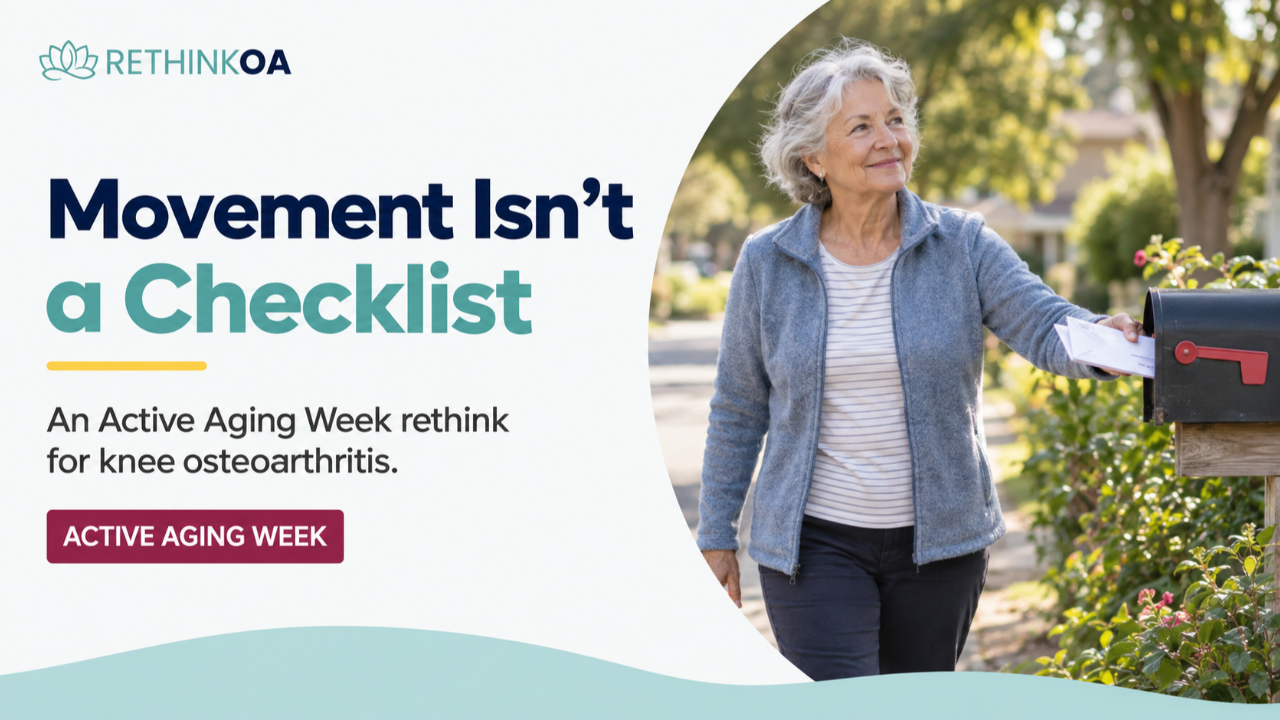
This week is Active Aging Week, an international campaign led by the International Council on Active Aging to celebrate what older adults can do—and to challenge the tired story that aging means slowing down and sitting out. I love this week. But I want to use it to gently push back on something I see even in well-meaning “stay active” advice.
Somewhere along the way, movement became a checklist. Thirty minutes. Five days. Ten thousand steps. Strength twice a week. Stretch daily. Each item is reasonable on its own—but stacked together, they turn movement into a set of boxes to tick, and a set of ways to fail. For many people with knee osteoarthritis, the checklist doesn’t motivate; it quietly convinces them that if they can’t do all of it, there’s no point doing any of it. This week, let’s trade the checklist for something truer, kinder, and—according to the research—more effective.
The Problem With the Checklist
Checklists make movement feel like a separate compartment of life: something you go do, in special clothes, for a set time, and then finish. That framing has two costs. First, it creates an all-or-nothing trap. Miss the 30 minutes and the day counts as a zero, so why bother with ten? Second, it makes movement conditional on the knee cooperating. On stiff days, the checklist gets abandoned entirely, and the guilt that follows makes tomorrow harder.
But that’s not how bodies work. Your joints, muscles, and nervous system don’t know the difference between a “workout” and carrying groceries up the stairs. They respond to load, frequency, and consistency—however it arrives. The U.S. Physical Activity Guidelines formally dropped the old 10-minute-minimum rule for exactly this reason: the evidence showed that all movement counts and accumulates.
What Movement Looks Like When It’s Woven In
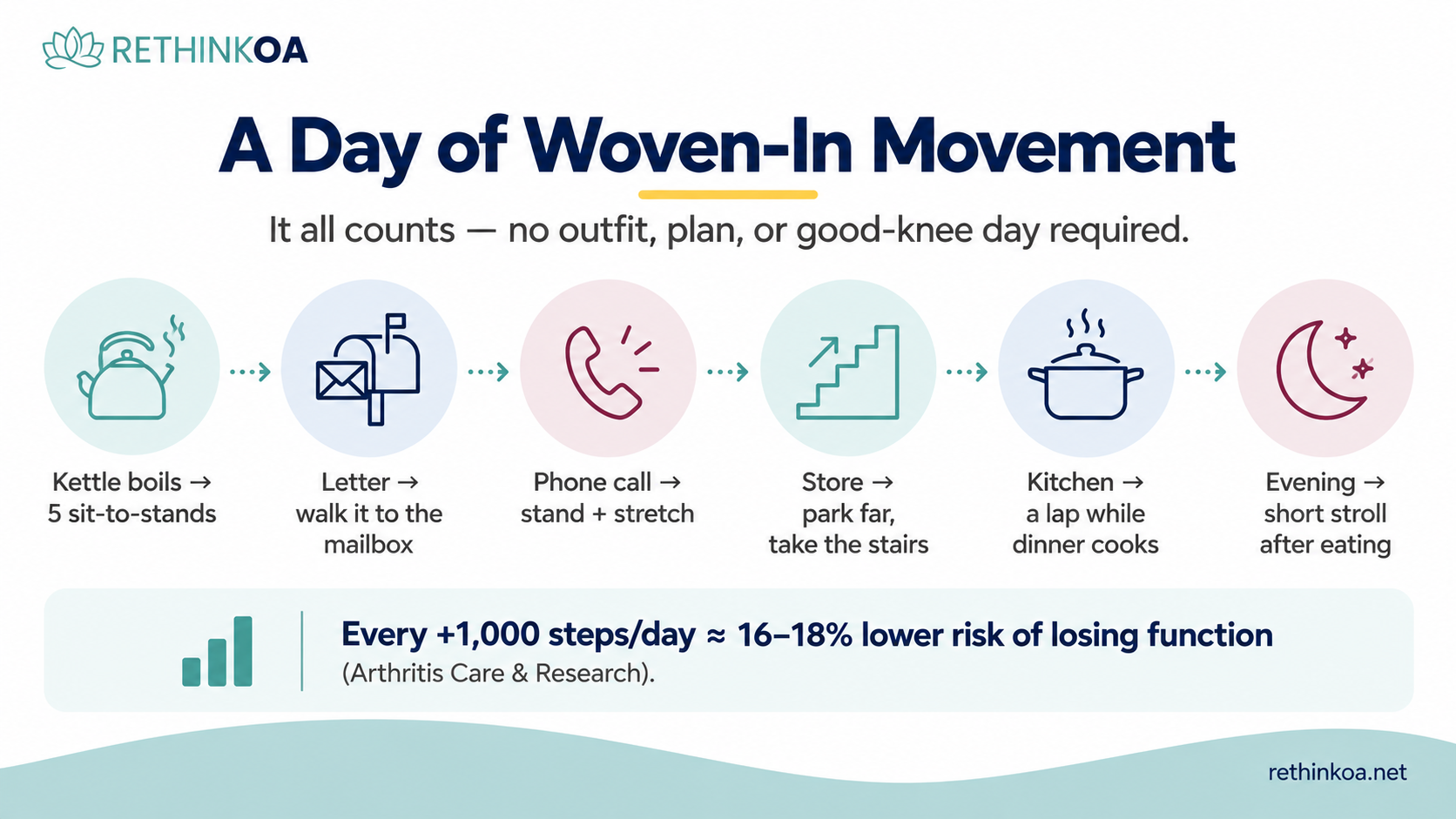
Picture a day where movement isn’t a task but a texture. You walk the letter to the mailbox instead of leaving it for the carrier. You park at the far end of the lot, or—if it’s close enough—you walk to the store. You take the stairs when they’re there. You stand up during phone calls. You do a few sit-to-stands while the kettle boils. None of it requires a plan, an outfit, or a good-knee day. And none of it feels like exercise—which may be exactly why it works.
The research is on the side of this approach. In people with or at risk of knee osteoarthritis, every additional 1,000 daily steps was associated with a 16–18% lower risk of developing functional limitation—and those steps were counted however they happened, errands included. Across the general population, health benefits climb steeply from low step counts, with the biggest gains at the bottom of the curve. Woven-in movement isn’t a consolation prize for people who can’t manage “real” exercise. It’s the real thing.
Why This Is Especially Good for Joints
Osteoarthritic joints tend to stiffen with long stillness and loosen with regular motion—that’s why the first steps after sitting are often the worst and things ease as you get going. Cartilage has no blood supply; it’s nourished by the gentle pumping of movement. So a day sprinkled with short bouts—the mailbox, the stairs, the kitchen laps—may keep a knee happier than one long session followed by hours in a chair. We covered this idea in Every Step Counts, and it’s echoed in the finding that aerobic activity like walking ranked most effective for knee osteoarthritis pain and function across 217 trials.
Woven-in movement also sidesteps the fear trap. When exercise is a big, deliberate event, every twinge during it feels like a verdict. When movement is just part of getting through your day, your nervous system learns something quieter and more useful: moving is normal, and my body handles it.
Keep the Structure—Lose the Scorecard
None of this means planned exercise is bad. A regular walk, a strength routine, a class you love—these are wonderful, and strength work in particular deserves a place in your week because strong muscles are your knee’s shock absorbers. The shift I’m suggesting is in the relationship: structure as scaffolding, not as a scorecard. Do the planned things when you can. Let the woven-in things carry the rest. And on the days the knee has opinions, let “I walked to the mailbox and did the stairs” count as a full win—because physiologically, it is one.
If you’d like practical ways to make movement easier to fit in, we wrote a whole guide on lowering the friction—habit stacking, movement snacks, and a bad-knee-day menu.
An Active Aging Week Invitation
Active Aging Week exists to change how we see aging—from a story of decline to one of possibility. I’d add one more rethink to that mission: let’s change how we see movement, too. Not a checklist you pass or fail. Not a separate chore for days when the knee cooperates. Just the ordinary, everyday texture of a life you’re still fully living—the mailbox, the market, the stairs, the grandkids, the garden. Every bit of it counts. Every bit of it is you, aging actively.
If fear is what stands between you and moving more freely, that’s exactly what Rethink OA was built and clinically tested to change—in under two hours, from home.
FAQ
Does everyday activity like walking to the mailbox really count as exercise?
Yes. Your joints, muscles, and cardiovascular system respond to movement regardless of whether it’s labeled “exercise.” The U.S. Physical Activity Guidelines removed the 10-minute-minimum-bout requirement because evidence shows all movement accumulates toward health benefits. For knee osteoarthritis, frequent short bouts may be especially helpful since joints stiffen with long stillness.
How much movement do I need each day with knee osteoarthritis?
There’s no single required amount. Research in people with or at risk of knee osteoarthritis found each additional 1,000 daily steps associated with a 16–18% lower risk of functional limitation, and around 6,000 steps a day was linked to staying functional. The most useful target is modestly more than you’re doing now, in whatever form fits your life.
Is it better to do one long workout or several short bouts?
Both provide benefits, and the best pattern is the one you’ll sustain. For osteoarthritic joints, several short bouts spread across the day may have an edge: they interrupt the stiffness that builds during long sitting and provide the regular gentle loading cartilage relies on for nutrition. Many people do best combining a planned session with woven-in daily movement.
What is Active Aging Week?
Active Aging Week is an annual international campaign led by the International Council on Active Aging (ICAA), held each October, that celebrates the abilities and possibilities of older adults and encourages communities to offer free, welcoming activity events. In 2026 it runs October 5–11.
Should I still do planned exercise if I move a lot during the day?
Ideally, yes—especially some strength work, since strong muscles support and protect the knee joint and daily activity alone doesn’t build much strength. Think of planned exercise as scaffolding and woven-in movement as the foundation. On days planned exercise isn’t possible, daily movement still counts fully.
About the Author
Melissa Boswell, PhD, is a bioengineer and digital health founder with nearly a decade of experience working in osteoarthritis, movement science, and human performance. She is the founder of Rethink OA, a clinically validated digital program developed from research conducted with collaborators at Stanford University and published in npj Digital Medicine. Her work focuses on helping people better understand pain, movement, and behavior change in osteoarthritis.

References
- International Council on Active Aging. Active Aging Week. https://www.activeagingweek.com/
- Piercy KL, et al. The Physical Activity Guidelines for Americans. JAMA. 2018;320(19):2020-2028. https://doi.org/10.1001/jama.2018.14854
- White DK, et al. Daily walking and the risk of incident functional limitation in knee osteoarthritis. Arthritis Care Res. 2014;66(9):1328-1336. https://pubmed.ncbi.nlm.nih.gov/24923633/
- Paluch AE, et al. Daily steps and all-cause mortality: a meta-analysis of 15 international cohorts. Lancet Public Health. 2022;7(3):e219-e228. https://doi.org/10.1016/S2468-2667(21)00302-9
- Yan L, et al. Comparative efficacy and safety of exercise modalities in knee osteoarthritis: systematic review and network meta-analysis. BMJ. 2025;391:e085242. https://doi.org/10.1136/bmj-2025-085242
- Boswell MA, et al. A randomized clinical trial testing digital mindset intervention for knee osteoarthritis pain and activity improvement. npj Digital Medicine. 2024. https://www.nature.com/articles/s41746-024-01281-8
Move More. Fear Pain Less.
Learn how to reduce pain, stay active, and support your joints—starting today.