
5 Ways to Make Exercise More Convenient When You Have Osteoarthritis
Sep 21, 2026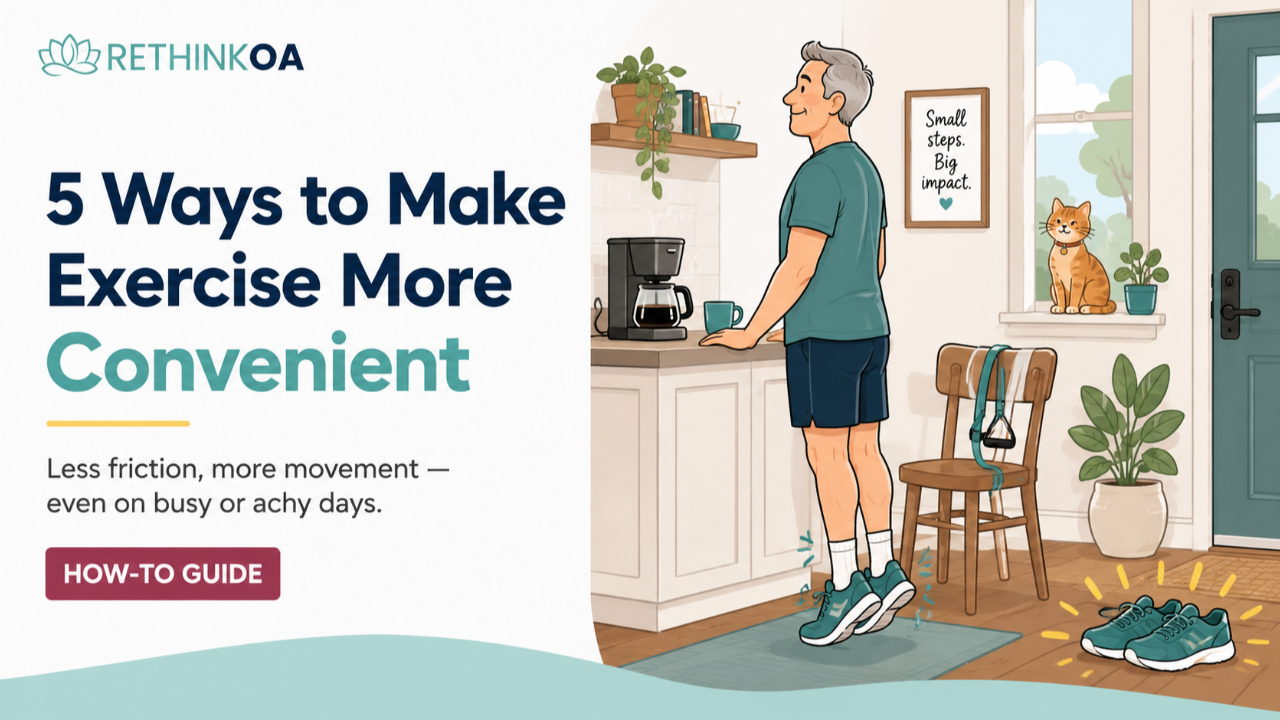
Here’s a quiet truth about exercise and osteoarthritis: most people don’t stop moving because they don’t care. They stop because movement became inconvenient—the gym is across town, the routine takes an hour, the knees need warming up, the day fills up, and by evening, the couch has won again. Then we blame ourselves for lacking willpower.
But behavioral research points somewhere more forgiving: consistency has less to do with willpower than with friction. When a behavior is easy to start, tied to an existing routine, and pleasant enough to repeat, it tends to stick—research on habit formation suggests habits are built through simple repetition in a consistent context, not through heroic effort. So instead of asking “How do I get more disciplined?”, this post asks a better question: how do we make movement so convenient it’s hard to skip? Here are five evidence-informed ways.
1. Shrink the Unit of Exercise
The single biggest convenience upgrade: stop treating thirty continuous minutes as the minimum ticket. The U.S. Physical Activity Guidelines dropped the old ten-minute-bout rule because evidence showed all movement counts, however it accumulates. Two minutes of sit-to-stands while the coffee brews. A lap around the house between phone calls. Calf raises while the microwave runs.
For osteoarthritis specifically, these “movement snacks” may be better than a single heroic session anyway: joints stiffen during prolonged stillness and are nourished by frequent, gentle loading, as we covered in Every Step Counts. Small units also protect you on symptom days—a flare might cancel a 45-minute workout, but it rarely cancels three 5-minute walks.
2. Attach Movement to Things You Already Do
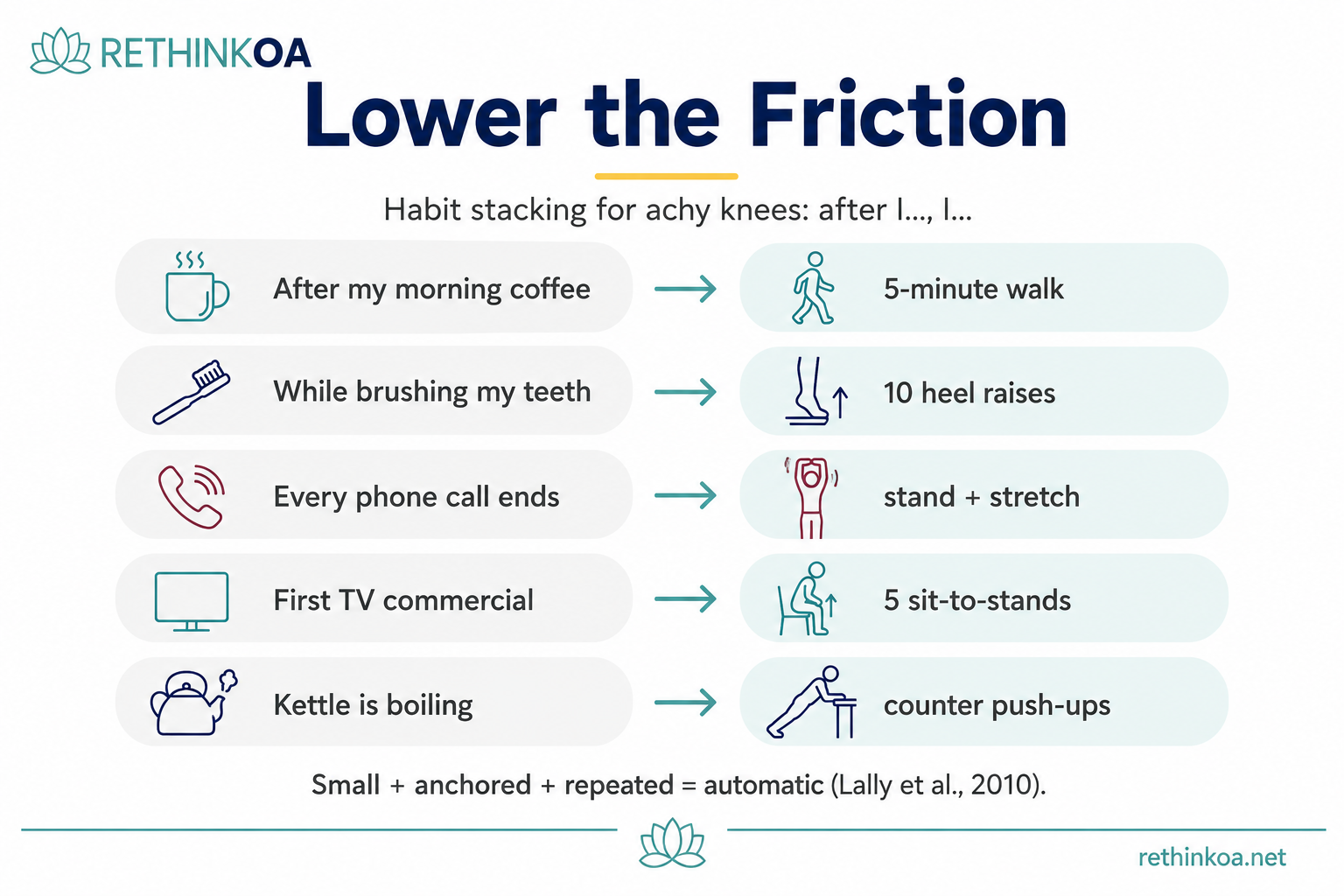
Every daily routine you already have—coffee, teeth brushing, the mail, the evening news—is a free anchor. Habit researchers call this cueing: behaviors repeated after a consistent cue become automatic over time, requiring less and less decision-making. The decision is where most exercise dies; anchoring removes the decision.
A few pairings that work well with achy knees: heel raises, or gentle knee bends while brushing teeth; a short walk that starts the moment you put the coffee cup in the sink; stretches during the first commercial break; a standing break every time you finish a phone call. The formula is simply after I [existing habit], I [tiny movement]—and the tinier the movement, the faster it becomes automatic.
3. Design Your Environment to Do the Remembering
Willpower lives in your head, where it’s easily outvoted by fatigue. Your environment, on the other hand, never forgets. Leave your walking shoes by the door—visible, laces loosened. Keep a resistance band looped over the chair you sit in most. Put the yoga mat where you’d have to step over it. Park a set of light weights next to the TV remote.
Each of these moves the “start” of exercise from a decision to a visual reminder, and shaves the setup time to seconds. The reverse works too: if the recliner swallows your evenings, make the first sitting option a firmer chair, and let the recliner be the after-movement reward.
4. Have a “Bad Knee Day” Menu Ready
Inconvenience isn’t just logistics—sometimes it’s your knee itself. The all-or-nothing trap says: symptoms are up, so exercise is off. The convenient alternative is a pre-planned menu of gentler options, decided before you need it, so a flare triggers a swap instead of a shutdown: water walking or pool exercises instead of the neighborhood loop; the stationary bike at an easy spin instead of hills; chair exercises and range-of-motion work instead of strength day; five minutes instead of twenty.
This is relative rest made practical—and having the menu written down (on the fridge, in your phone) removes the mid-flare decision-making that usually ends in doing nothing. Remember the 24-hour rule: if symptoms settle within a day, the dose was fine.
5. Let Enjoyment Carry the Load
The most underrated convenience feature is wanting to do the thing. A walk with a friend gets scheduled and kept; a walk assigned by guilt gets postponed. Music from your favorite decade, a podcast saved only for walks, a scenic route, a class where people know your name—these aren’t garnishes, they’re adherence strategy. Research consistently suggests that enjoyable, social, convenient activity is the kind people actually sustain—and the best-supported exercise for knee osteoarthritis happens to be walking, cycling, and swimming: activities that pair beautifully with company, podcasts, and pleasant scenery.
If exercise has felt like a chore for years, we wrote a whole post on making it enjoyable again—because the exercise you look forward to is the only kind that survives a busy life.
Final Thoughts
If moving more were only about knowing it helps, everyone with osteoarthritis would be moving. The real battle is fought in logistics: decisions, setup, distance, time, and symptom days. Win those small battles—shrink the units, anchor to routines, stage your environment, pre-plan your flare menu, and choose what you enjoy—and consistency stops requiring courage. Convenience isn’t cheating. It’s how bodies that ache get to keep their habits.
And if the barrier isn’t logistics but the worry that movement will make things worse, that fear is exactly what Rethink OA was clinically shown to reduce.
FAQ
How can I exercise with osteoarthritis if I have no time?
Shrink the unit. Official physical activity guidelines no longer require ten-minute minimum bouts—all movement counts and accumulates. Two-to-five-minute “movement snacks” attached to existing routines (after coffee, during TV, between calls) add up meaningfully, and for stiff joints, frequent short bouts are often more comfortable than one long session.
What is habit stacking for exercise?
Habit stacking means attaching a small movement to a routine you already do daily: “After I brush my teeth, I do ten heel raises.” Research on habit formation suggests behaviors repeated after a consistent cue become increasingly automatic over time—removing the daily decision that usually derails exercise plans.
How do I keep exercising during an osteoarthritis flare?
Prepare a “bad knee day” menu in advance: gentler swaps like water exercise, easy cycling, chair-based movements, or shorter walks. During a flare, reduce rather than stop (relative rest), then rebuild using the 24-hour rule—if symptoms settle within a day, the dose was appropriate. Deciding the menu ahead of time prevents the flare-day default of doing nothing.
What's the easiest exercise to stay consistent with for knee osteoarthritis?
For most people: walking—it requires no equipment, pairs with company and podcasts, and aerobic exercise ranked most effective for knee osteoarthritis in a 2025 analysis of 217 trials. That said, the honest answer is whichever appropriately dosed activity you enjoy enough to repeat; enjoyment predicts consistency better than any ranking.
Does exercise have to feel hard to help osteoarthritis?
No. Research shows benefits from low-to-moderate intensity activity, and comfort matters for consistency. Gentle, regular movement supports joint health, strength, and pain over time—and consistency at a comfortable level outperforms occasional intense efforts followed by long gaps.
About the Author
Melissa Boswell, PhD, is a bioengineer and digital health founder with nearly a decade of experience working in osteoarthritis, movement science, and human performance. She is the founder of Rethink OA, a clinically validated digital program developed from research conducted with collaborators at Stanford University and published in npj Digital Medicine. Her work focuses on helping people better understand pain, movement, and behavior change in osteoarthritis.

References
- Lally P, van Jaarsveld CHM, Potts HWW, Wardle J. How are habits formed: modelling habit formation in the real world. Eur J Soc Psychol. 2010;40(6):998-1009. https://doi.org/10.1002/ejsp.674
- Piercy KL, et al. The Physical Activity Guidelines for Americans. JAMA. 2018;320(19):2020-2028. https://doi.org/10.1001/jama.2018.14854
- Yan L, et al. Comparative efficacy and safety of exercise modalities in knee osteoarthritis: systematic review and network meta-analysis. BMJ. 2025;391:e085242. https://doi.org/10.1136/bmj-2025-085242
- World Health Organization. Physical activity fact sheet. https://www.who.int/news-room/fact-sheets/detail/physical-activity
- Boswell MA, et al. A randomized clinical trial testing digital mindset intervention for knee osteoarthritis pain and activity improvement. npj Digital Medicine. 2024. https://www.nature.com/articles/s41746-024-01281-8
Move More. Fear Pain Less.
Learn how to reduce pain, stay active, and support your joints—starting today.