
Every Step Counts: Why Small Amounts of Movement Matter for Osteoarthritis
Aug 31, 2026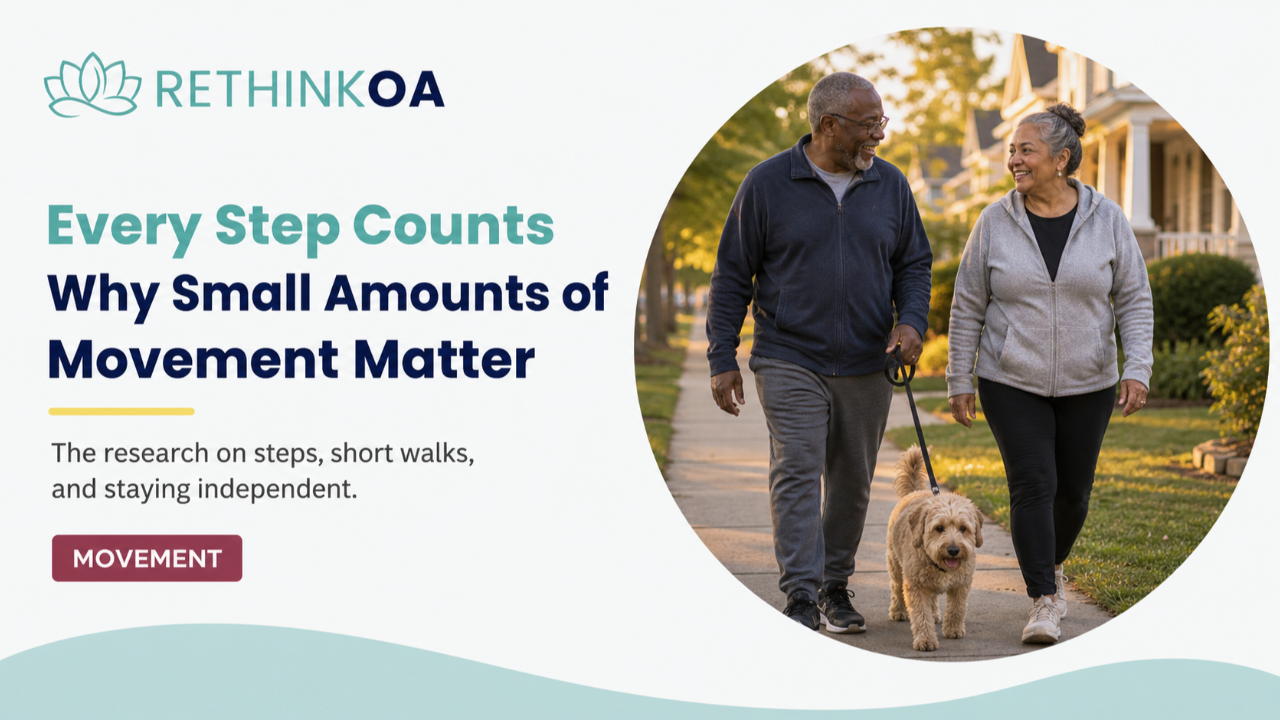
Somewhere along the way, most of us absorbed a set of rules about what “real” exercise requires: 10,000 steps. Thirty minutes minimum. Break a sweat, or it doesn’t count. And when knee osteoarthritis makes those numbers feel out of reach, the rules deliver their quiet verdict: if you can’t do enough, why do anything?
Here’s what the research actually says: those rules are mostly folklore. The benefits of movement start far lower than most people think; they arrive in pieces as small as a few minutes, and for people with knee osteoarthritis specifically, modest daily movement is associated with staying functional and independent. If all-or-nothing thinking has been keeping you at “nothing,” this post is your permission slip for “something.”
10,000 Steps Was Never the Science
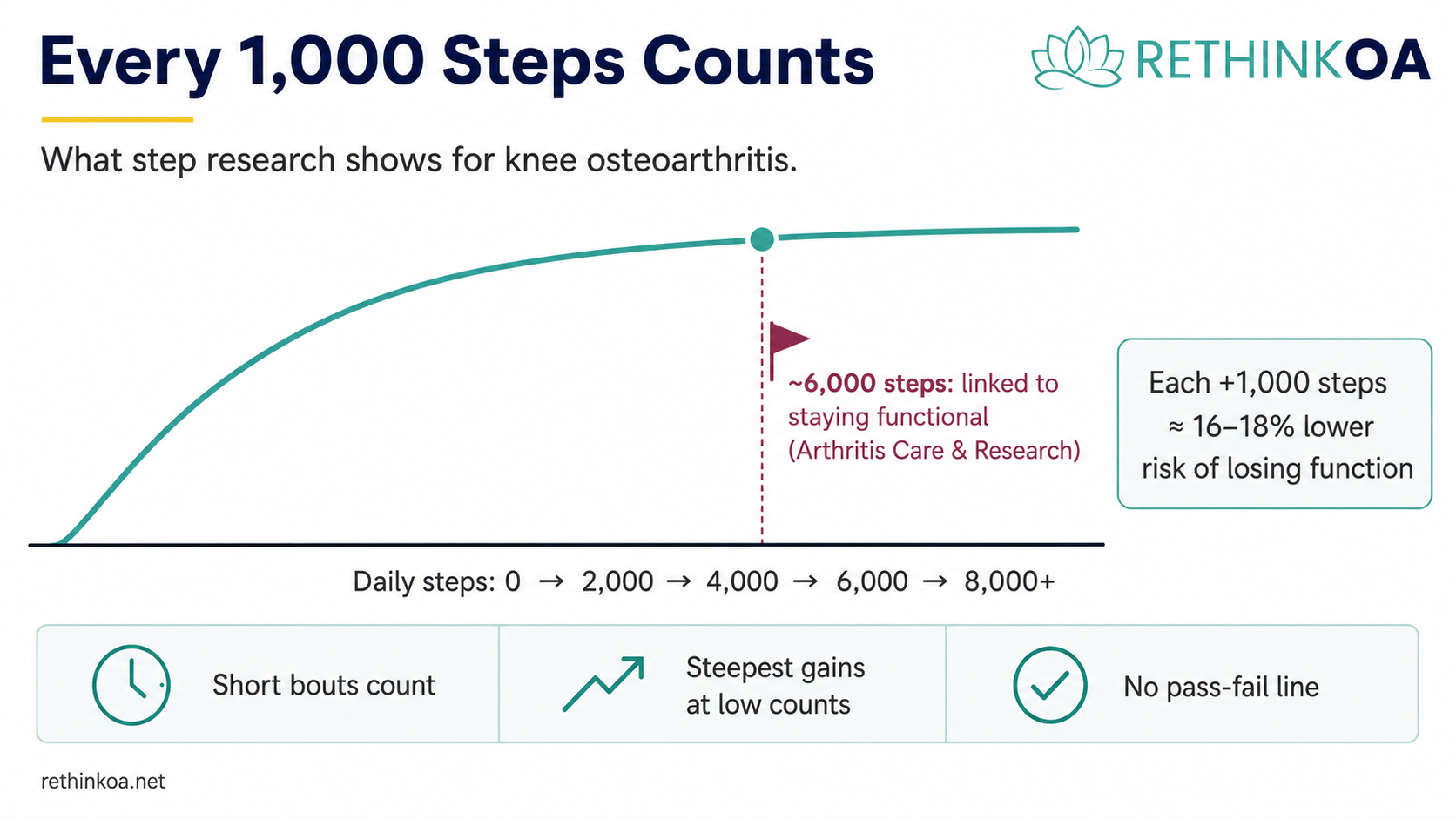
The 10,000-step target traces back to a 1960s Japanese pedometer marketing campaign—not to research. When scientists actually studied the question, the picture looked very different. A large pooled analysis in The Lancet Public Health, covering fifteen studies and nearly 50,000 adults, found that health benefits rise steeply from very low step counts, with meaningful risk reductions well below 10,000 steps, and for older adults, benefits leveled off around 6,000–8,000 steps per day.
Read that again: the steepest gains happen at the bottom of the curve. Going from 2,000 to 4,000 steps buys you more than going from 8,000 to 10,000. If you’re starting low, you’re not behind—you’re positioned for the biggest returns available.
The 6,000-Step Finding for Knee Osteoarthritis
What about arthritic knees specifically? Researchers followed nearly 1,800 people with or at risk of knee osteoarthritis, measuring their daily steps and then tracking who developed mobility problems—such as difficulty rising from a chair or climbing stairs—two years later. The findings, published in Arthritis Care & Research, were remarkably encouraging: each additional 1,000 steps per day was associated with a 16–18% reduction in the risk of developing functional limitation, and walking around 6,000 steps per day best distinguished those who stayed functional from those who didn’t.
Two things I love about that number. First, 6,000 steps isn’t a workout—it’s a life with some walking in it: errands, a stroll after dinner, the long way to the mailbox. Second, the 16–18% per 1,000 steps means there’s no cliff to fall off and no threshold to fail. Every thousand steps is doing something. Every step counts isn’t a slogan; it’s roughly how the dose-response curve works.
Short Bouts Count. Officially.
For decades, official guidance said exercise only counted in bouts of ten minutes or more. When the U.S. Physical Activity Guidelines were updated, that requirement was removed entirely—the evidence showed that all movement accumulates: two minutes here, five minutes there, stairs instead of the elevator, a lap around the kitchen while the kettle boils.
For osteoarthritis, short and frequent may actually be the smarter pattern, not the consolation prize. Joints tend to stiffen with long stillness and ease with regular motion—cartilage gets its nutrition from the gentle pumping of movement, as we covered in why total rest backfires. Sprinkling “movement snacks” through the day keeps the joint fed and the stiffness down in a way a single heroic session, followed by hours in a chair, doesn’t.
Why Small Wins Beat Big Plans
There’s a psychological reason to start small, too, and by now regular readers will see it coming: confidence. Grand plans that collapse teach your brain that you can’t. Small plans that succeed teach your brain that you can—and research suggests that self-efficacy is one of the strongest psychological predictors of long-term outcomes in osteoarthritis. A five-minute walk completed is worth more than a five-mile walk imagined.
So shrink the commitment until it’s almost embarrassing, then let it grow on its own. Park one row farther out. Take the phone call standing. Walk to the corner and back after dinner. Attach steps to things you already do, and count all of it—because your joints do. If you want a structured way to build up from here, the five-step guide covers dosing and the 24-hour rule; if walking bores you, make it something you enjoy.
A Note for the Holiday Weekend
This post lands as the U.S. heads into Labor Day weekend—a fitting time for it. You don’t need a training plan for the holiday. Instead, you can try a walk after the barbecue, a stroll with a grandkid, or ten extra minutes on your feet at the farmers market. That’s not “not really exercising.” According to the best evidence we have, that’s the real thing, accumulating exactly the way your body counts it.
Final Thoughts
The all-or-nothing rules were never real. The research shows benefits beginning at the first steps, rising fastest exactly where beginners live, accumulating in bouts too small to feel like workouts, and—for knee osteoarthritis—protecting the independence that matters most. Every step counts. Your knees have been keeping score correctly all along; it’s the rules in our heads that needed fixing.
And if what stands between you and those first steps is fear rather than time, Rethink OA was clinically shown to help people move more and fear pain less—in under two hours.
FAQ
How many steps a day should I walk with knee osteoarthritis?
Research in people with or at risk of knee osteoarthritis found that around 6,000 steps per day was associated with maintaining physical function two years later, and each additional 1,000 steps was associated with a 16–18% lower risk of developing functional limitation. There’s no magic threshold, though: benefits accumulate from very low counts, so the best target is modestly above wherever you are now.
Do I really need 10,000 steps a day?
No. The 10,000 figure came from marketing, not science. Large pooled analyses show health benefits rising steeply from low step counts, with benefits for older adults leveling off around 6,000–8,000 steps per day. The biggest health returns come from moving out of the lowest activity levels—not from chasing five figures.
Does walking in short bouts count as exercise?
Yes—officially. The U.S. Physical Activity Guidelines removed the old 10-minute minimum rule because evidence showed that all movement accumulates toward health benefits. For osteoarthritis, short frequent bouts may be especially useful, since joints stiffen with prolonged stillness and cartilage is nourished by regular gentle loading.
Is walking enough exercise for knee osteoarthritis?
Walking is one of the best-supported activities for knee osteoarthritis—a recent analysis of 217 trials ranked aerobic exercise, such as walking, as the most effective for pain and function. Adding some strengthening for the muscles around the knee is ideal, but if you do only one thing, a regular walk is an excellent choice.
What if even short walks increase my knee pain?
Start smaller—even a few minutes—and use the 24-hour rule: if symptoms settle back to baseline within a day, the dose was fine to repeat or build on. Flat routes, supportive shoes, and breaking walks into pieces all help. If walking remains consistently aggravating, options like cycling or water walking offer similar benefits with lower impact, and a physical therapist can help tailor a plan.
About the Author
Melissa Boswell, PhD, is a bioengineer and digital health founder with nearly a decade of experience working in osteoarthritis, movement science, and human performance. She is the founder of Rethink OA, a clinically validated digital program developed from research conducted with collaborators at Stanford University and published in npj Digital Medicine. Her work focuses on helping people better understand pain, movement, and behavior change in osteoarthritis.

References
- Paluch AE, et al. Daily steps and all-cause mortality: a meta-analysis of 15 international cohorts. Lancet Public Health. 2022;7(3):e219-e228. https://doi.org/10.1016/S2468-2667(21)00302-9
- White DK, et al. Daily walking and the risk of incident functional limitation in knee osteoarthritis: an observational study. Arthritis Care Res. 2014;66(9):1328-1336. https://pubmed.ncbi.nlm.nih.gov/24923633/
- Piercy KL, et al. The Physical Activity Guidelines for Americans. JAMA. 2018;320(19):2020-2028. https://doi.org/10.1001/jama.2018.14854
- Yan L, et al. Comparative efficacy and safety of exercise modalities in knee osteoarthritis: systematic review and network meta-analysis. BMJ. 2025;391:e085242. https://doi.org/10.1136/bmj-2025-085242
- Boswell MA, et al. Mindset and physical activity intervention for adults with knee osteoarthritis. npj Digital Medicine. 2024. https://www.nature.com/articles/s41746-024-01281-8
Move More. Fear Pain Less.
Learn how to reduce pain, stay active, and support your joints—starting today.