
How to Talk to Yourself When Osteoarthritis Feels Discouraging
Aug 03, 2026
There’s a conversation happening in your head about your osteoarthritis. It runs all day, mostly unnoticed. On hard days, it sounds like: My knee is ruined. I’m falling apart. I’ll never hike again. What’s the point of exercising if this is where I end up?
I want to be clear from the start: feeling discouraged with osteoarthritis is normal. It is not a weakness, and it is not a character flaw. But here’s what decades of psychology research suggest: how you talk to yourself about pain isn’t just commentary—it influences how much pain interferes with your life, what you do next, and even how pain feels. The good news is that self-talk is a skill. And skills can be practiced.
Why the Words in Your Head Matter
Psychologists have a name for the most painful style of pain self-talk: catastrophizing—dwelling on worst-case scenarios, feeling helpless, and mentally magnifying threat. It’s measured by a well-validated scale used in thousands of studies, and the findings are remarkably consistent: higher catastrophizing is associated with more pain, more disability, and worse outcomes across chronic pain conditions, including osteoarthritis.
This isn’t because pain is “in your head.” It’s because your brain produces pain based partly on how dangerous it believes the situation is. Thoughts like my joint is crumbling tell your protective systems to stay on high alert—amplifying the very signals you’re worried about. The words aren’t just describing your experience. They’re helping shape it.
Self-Compassion Outperforms Self-Criticism
Many people respond to discouragement with drill-sergeant tactics: Stop whining. Push through. Others have it worse. It feels productive, but research suggests it backfires—self-criticism tends to increase distress and reduce follow-through.
The alternative isn’t pretending everything’s fine. It’s self-compassion: speaking to yourself the way you’d speak to a good friend with knee pain. In a study of people with persistent musculoskeletal pain, those with more self-compassion reported less catastrophizing, less pain-related disability, and more positive emotion. Think about what you’d actually say to that friend: “Of course, this is frustrating. You’re dealing with a lot. What’s one small thing that usually helps?” You’d never say, “You’re broken, and it’s only going to get worse.” Yet that’s exactly how many of us talk to ourselves.
A Small Trick With Big Evidence: Use Your Own Name
One of my favorite findings in this area: the words you use to refer to yourself change how well you handle hard moments. Research published in the Journal of Personality and Social Psychology found that people who coached themselves through stressful situations using their own name or “you”—instead of “I”—regulated their emotions better and appraised challenges as less threatening.
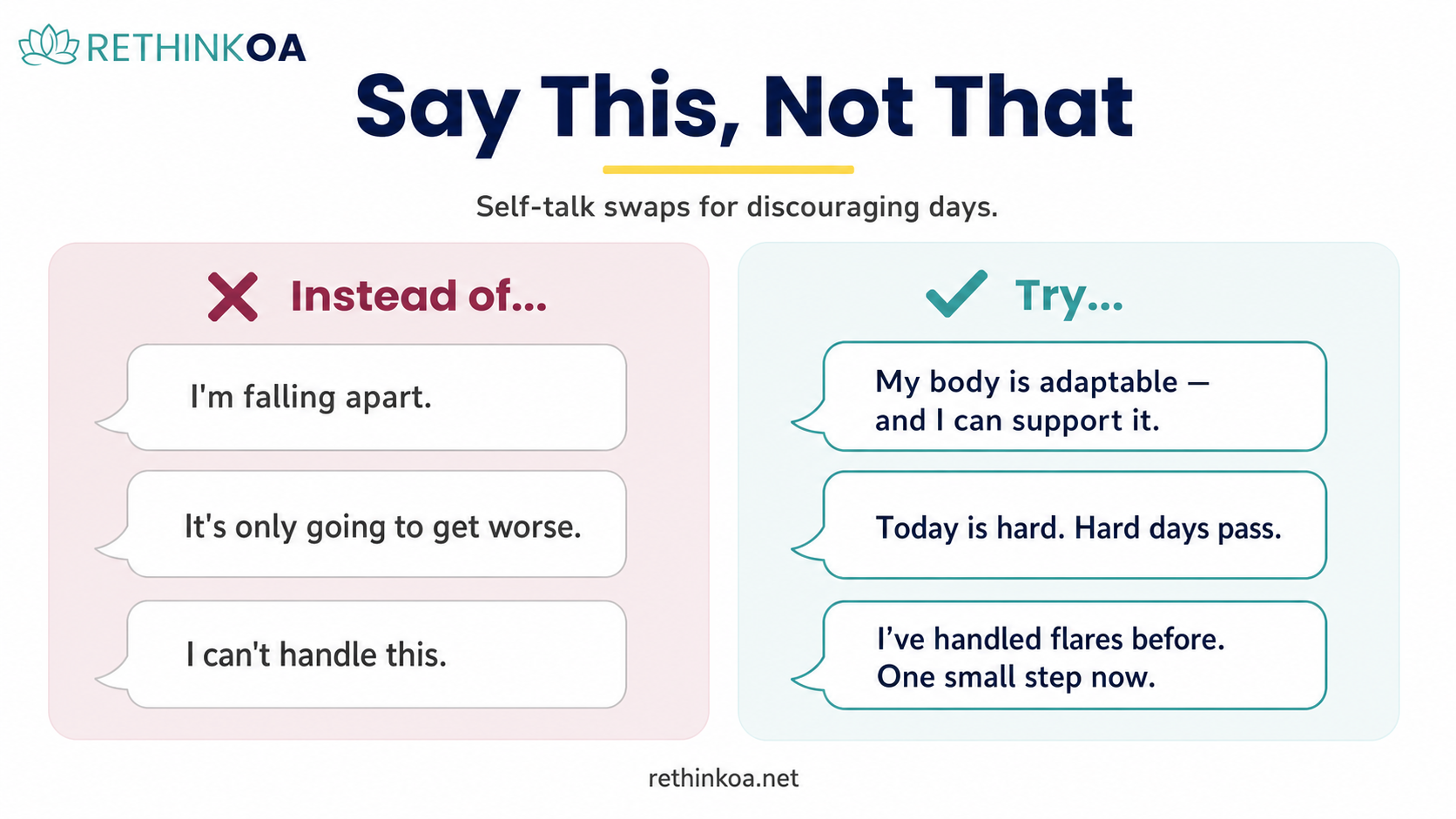
Applied to a flare day, the difference sounds like this. Instead of “I can’t handle this,” try: “Okay, Melissa. Your knee is loud today. You’ve been through flares before, and they pass. What’s the gentlest way to keep moving today?” That tiny bit of distance turns you from the person drowning in the problem into the coach standing beside it.
Three Shifts to Practice This Week
First, notice without judging. You can’t change a conversation you can’t hear. When discouragement hits, pause and ask: What am I telling myself right now? Just naming the thought—there’s the “I’m falling apart” story again—loosens its grip. Don’t scold yourself for having the thought; noticing it is the win.
Second, check the evidence. Discouraged self-talk usually smuggles in predictions dressed as facts. “It’s only going to get worse” is a forecast—and the research says it’s often wrong: symptoms can improve with the right approach, and many people improve without surgery. Swap the verdict for something accurate and useful: “Today is hard. Hard days pass. There are things I can do that help.”
Third, end with one small action. Discouragement feeds on helplessness, so the most powerful reply to it is proof you’re not helpless: a five-minute walk, three sit-to-stands, a stretch, a text to a friend. Small actions don’t just improve symptoms—they rebuild the confidence that discouragement erodes.
This Isn’t Toxic Positivity
Let me head off a fair objection: none of this means slapping a smile over real pain, and none of it means osteoarthritis is your fault for “thinking wrong.” Pain is real, flare days are real, and grief over activities that have gotten harder is real. Helpful self-talk doesn’t deny any of that. It simply refuses to add a second layer of suffering on top—the layer made of harsh verdicts and dark forecasts. Realistic, kind, and action-oriented beats both fake cheerfulness and self-punishment.
If your discouragement is constant, heavy, or feels like depression, please talk to your doctor or a mental health professional—that’s not a self-talk problem, and support helps.
Final Thoughts
You will have discouraging days with osteoarthritis—everyone does. The goal isn’t to silence the inner critic forever. It’s important to notice it sooner, respond more kindly, and end the conversation with one small action. Over time, those small conversations change what you believe your body can do. And that belief changes what it does.
This is the heart of what we teach in Rethink OA—a short, clinically studied program on rethinking pain, movement, and what’s possible with osteoarthritis.
FAQ
Can self-talk really affect osteoarthritis pain?
Research suggests it can influence the experience of pain. Pain catastrophizing—dwelling on worst-case interpretations—is consistently associated with higher pain and disability, while self-compassion and confident, action-oriented thinking are associated with better coping and function. Self-talk doesn’t change the joint itself, but it influences the nervous system’s protectiveness, your stress levels, and the choices you make each day.
What is pain catastrophizing?
Catastrophizing is a thinking pattern involving rumination (“I can’t stop thinking about the pain”), magnification (“this means something terrible”), and helplessness (“nothing I do matters”). It’s common and understandable—not a personal failing—but research links it to worse pain outcomes, which is why learning to notice and reframe it is a core part of many evidence-based pain programs.
How do I stop negative thoughts about my arthritis?
The goal isn’t to stop them—thoughts don’t respond well to suppression. Instead: notice the thought without judgment, question its predictions against evidence, and respond with something accurate and kind, ideally followed by one small action. Using your own name (“Okay, [name], you’ve handled flares before”) has research support as a way to create helpful distance.
Is being positive enough to improve osteoarthritis?
No—and that’s not what the research suggests, either. Forced positivity that denies real difficulty tends not to help. What’s associated with better outcomes is realistic, compassionate, action-oriented thinking combined with evidence-based care: appropriately dosed exercise, good sleep, weight management where relevant, and support from your care team.
When should I get help for discouragement about my arthritis?
If low mood is persistent, affects your sleep or appetite, drains interest in things you usually enjoy, or feels like depression, talk to your doctor or a mental health professional. Depression is common alongside chronic pain; it’s treatable, and getting support often improves pain management too.
About the Author
Melissa Boswell, PhD, is a bioengineer and digital health founder with nearly a decade of experience working in osteoarthritis, movement science, and human performance. She is the founder of Rethink OA, a clinically validated digital program developed from research conducted with collaborators at Stanford University and published in npj Digital Medicine. Her work focuses on helping people better understand pain, movement, and behavior change in osteoarthritis.
References
- Sullivan MJL, Bishop SR, Pivik J. The Pain Catastrophizing Scale: development and validation. Psychological Assessment. 1995;7(4):524-532. https://doi.org/10.1037/1040-3590.7.4.524
- Wren AA, Somers TJ, Wright MA, et al. Self-compassion in patients with persistent musculoskeletal pain: relationship of self-compassion to adjustment to persistent pain. J Pain Symptom Manage. 2012;43(4):759-770. https://www.sciencedirect.com/science/article/pii/S0885392411004088
- Kross E, Bruehlman-Senecal E, Park J, et al. Self-talk as a regulatory mechanism: how you do it matters. J Pers Soc Psychol. 2014;106(2):304-324. https://doi.org/10.1037/a0035173
- Boswell MA, et al. Mindset and physical activity intervention for adults with knee osteoarthritis. npj Digital Medicine. 2024. https://www.nature.com/articles/s41746-024-01281-8
- National Institute of Arthritis and Musculoskeletal and Skin Diseases (NIAMS). Osteoarthritis. https://www.niams.nih.gov/health-topics/osteoarthritis
Move More. Fear Pain Less.
Learn how to reduce pain, stay active, and support your joints—starting today.