
What We Learned From 400+ People in Our Osteoarthritis Trial
Sep 07, 2026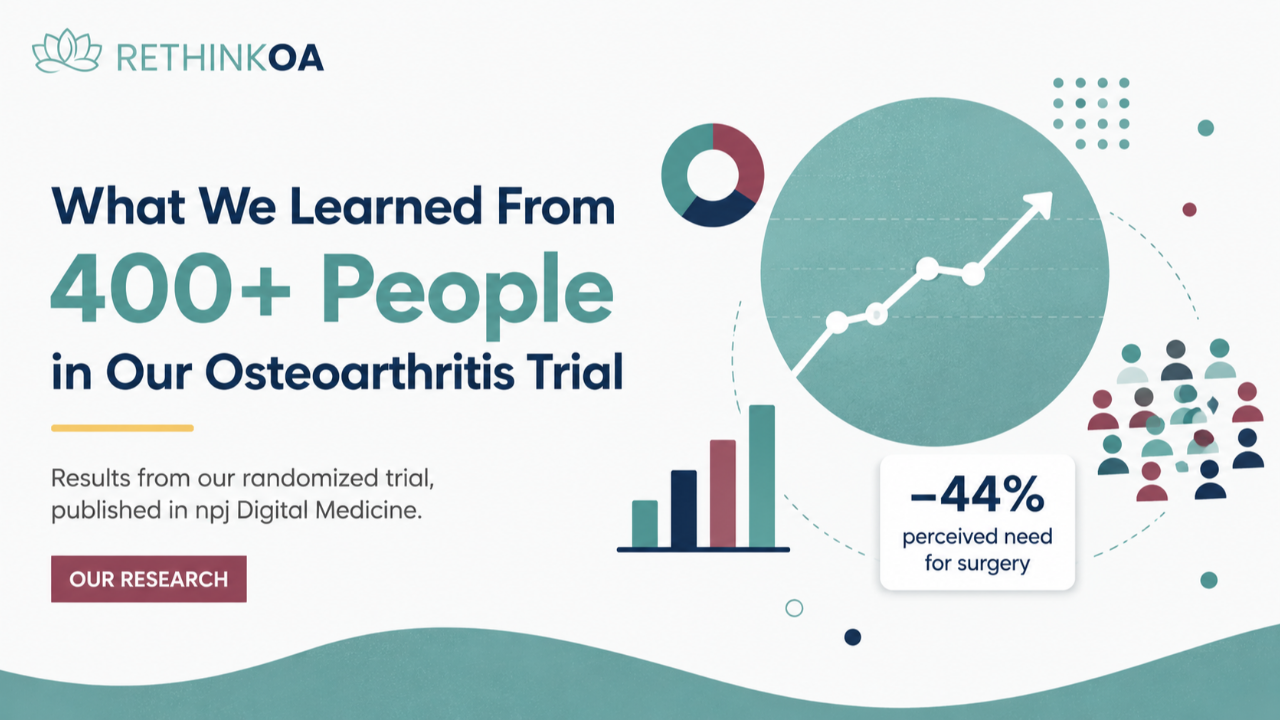
A few years ago, my collaborators and I asked a question that felt almost too simple: if we changed how people think about osteoarthritis and exercise—nothing else—would their lives actually change? No new medication. No exercise prescription. No clinic visits. Just a short series of videos designed to shift the story people tell themselves about their knees.
To find out, we ran a randomized clinical trial, and more than 400 people with knee osteoarthritis across the U.S. completed it. The results were published in npj Digital Medicine, a Nature Portfolio journal. This week, I want to walk you through what we did, what we found, what surprised us—and what it means for anyone living with knee osteoarthritis.
How the Study Worked
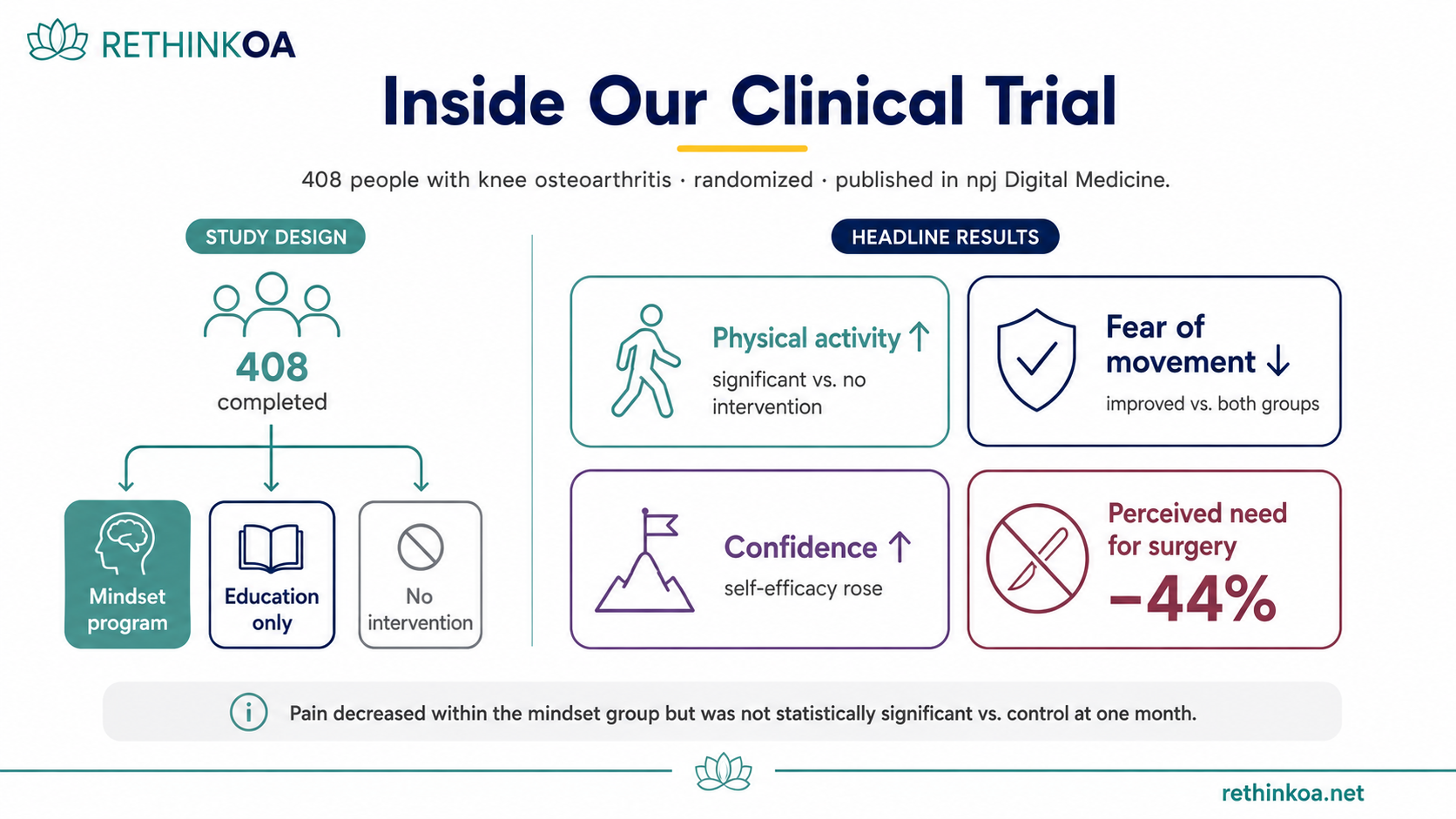
We recruited adults with knee osteoarthritis—7,210 people took our screening survey, and 458 enrolled and were randomized. The 408 who completed everything averaged about 64 years old, and 61% were women. Each person was randomly assigned to one of three groups:
- The mindset group watched our digital intervention: short videos teaching accurate, empowering ways to think about osteoarthritis (it’s manageable, not a catastrophe) and exercise (it can be enjoyable, not just endured)—featuring orthopedic surgeon Dr. Nick Giori, movement scientist Dr. Scott Delp, and mindset researcher Dr. Alia Crum.
- The education group received a standard informational program about osteoarthritis—the facts, without the mindset framing.
- The no-intervention group completed the same surveys but received no program, allowing us to make a true comparison.
Then we measured what happened—immediately after the program and one month later. The trial was prospectively registered, and no participants reported serious adverse events.
What Improved: Mindsets, Activity, and Fear
The clearest finding: mindsets moved—a lot. People who completed the mindset program showed large shifts in how they viewed their osteoarthritis: the belief that osteoarthritis is a catastrophe dropped sharply, while the belief that osteoarthritis is manageable—and even an opportunity to prioritize my health—rose, with what researchers call large effect sizes. Beliefs about exercise became more positive, too.
And those beliefs showed up in behavior. One month later, the mindset group reported significantly greater increases in physical activity than people who received no intervention. They also improved more than both other groups—including the education group—on several outcomes I care deeply about:
- Fear of movement went down—the fear that so often shrinks people’s lives more than the arthritis itself
- Self-imposed physical limitations decreased—fewer “I just can’t do that anymore” rules
- Self-efficacy increased—the confidence to manage symptoms that predicts long-term outcomes
- Perceived need for surgery dropped substantially—by roughly 44%
What Didn’t Reach Significance—and Why I’m Telling You Anyway
Science deserves honest reporting, so here’s the full picture. Knee pain in the mindset group did decrease slightly from baseline, but the difference compared to the no-intervention group didn’t reach statistical significance at one month. A two-hour program didn’t significantly “fix” pain in thirty days—and honestly, that’s the result I’d expect from something this brief, this early.
Here’s why that doesn’t discourage me: the things that did change—activity, fear, confidence, self-imposed limits—are precisely the ingredients that research links to better pain and function over the long run. Exercise is the first-line treatment for knee osteoarthritis, but it only works for people who actually feel safe doing it. Our trial suggests that a short digital program can remove the psychological barriers that stand between people and the treatment that works. The mindset shift isn’t the whole journey—it’s the unlocked door.
The Finding That Moved Me Most
Of everything we measured, the 44% drop in perceived need for surgery is the one I keep coming back to. Think about what that means: before the program, many participants believed a knee replacement was more or less inevitable. Two hours of videos later—videos containing nothing but accurate science, delivered with care—that belief loosened for many people.
Nobody’s joint changed during those two hours. What changed was the story. And as we’ve written before, the “surgery is inevitable” story was never accurate to begin with—most people have far more room to improve than they’ve been led to believe. Watching data confirm that beliefs this heavy can shift this quickly is, for me, the most hopeful finding in the whole paper.
What This Means If You Have Knee Osteoarthritis
Three takeaways I’d offer from this work:
- Your beliefs about osteoarthritis are not fixed personality traits—they’re learned, which means they can be re-learned, even later in life, even after years of discouraging messages.
- The psychological side of osteoarthritis isn’t a soft add-on to “real” treatment; in our data, it was the lever that moved behavior, and behavior is where long-term outcomes are built.
- This kind of help doesn’t have to be expensive or time-consuming—our entire intervention took less time than most people spend waiting in a single appointment's waiting room.
Mindset isn’t a cure, and it doesn’t replace movement, strength, sleep, or your care team. But it may be the piece that makes all the others possible.
Try It Yourself
The program we tested in this trial is what became Rethink OA—the same videos, the same science, now available to anyone. If you’ve been feeling stuck, afraid to move, or quietly resigned to surgery, it was built—and tested—for exactly where you are.
FAQ
What is the Rethink OA clinical trial?
It was a randomized clinical trial, published in npj Digital Medicine (a Nature Portfolio journal), testing whether a short digital mindset program could improve physical activity and pain in people with knee osteoarthritis. 408 participants completed the study, randomized to a mindset intervention, an education program, or no intervention. The trial was prospectively registered on ClinicalTrials.gov (NCT05698368).
What did the osteoarthritis mindset trial find?
The mindset group showed large improvements in beliefs about osteoarthritis and exercise, significantly increased physical activity compared to no intervention, and greater improvements than both comparison groups in fear of movement, self-imposed physical limitations, self-efficacy, and perceived need for surgery (which dropped by roughly 44%). Knee pain decreased slightly within the mindset group, but that change was not statistically significant compared to the control group at one month.
Can a mindset program really reduce the need for knee surgery?
The trial measured perceived need for surgery—how strongly participants believed they would need a knee replacement—which dropped substantially after the program. That matters because the belief that surgery is inevitable often shapes people’s choices and engagement with effective non-surgical care. Whether the program changes actual surgery rates over years is a question for longer-term research.
Is a digital program a replacement for exercise or medical care?
No. Exercise, weight management where relevant, sleep, and guidance from your care team remain the foundation of osteoarthritis management. What the trial suggests is that a brief mindset program can reduce the fear and discouragement that stop many people from engaging with those treatments—making it a complement to good care, not a substitute.
How long does the Rethink OA program take?
The program tested in the trial takes under two hours total, delivered as short videos you can watch from home at your own pace. Participants in the trial completed it over about two weeks, and there were no serious adverse events reported.
About the Author
Melissa Boswell, PhD, is a bioengineer and digital health founder with nearly a decade of experience working in osteoarthritis, movement science, and human performance. She is the founder of Rethink OA, a clinically validated digital program developed from research conducted with collaborators at Stanford University and published in npj Digital Medicine. Her work focuses on helping people better understand pain, movement, and behavior change in osteoarthritis.
References
- Boswell MA, et al. A randomized clinical trial testing digital mindset intervention for knee osteoarthritis pain and activity improvement. npj Digital Medicine. 2024. https://www.nature.com/articles/s41746-024-01281-8
- ClinicalTrials.gov registration NCT05698368. https://clinicaltrials.gov/study/NCT05698368
- Kolasinski SL, et al. 2019 American College of Rheumatology/Arthritis Foundation Guideline for the Management of Osteoarthritis of the Hand, Hip, and Knee. Arthritis Care Res. 2020;72(2):149-162. https://pubmed.ncbi.nlm.nih.gov/31908163/
- Boswell MA, et al. Mindset is associated with future physical activity and management strategies in individuals with knee osteoarthritis. Ann Phys Rehabil Med. 2022;65(4):101634. https://doi.org/10.1016/j.rehab.2022.101634
- Crum AJ, Salovey P, Achor S. Rethinking stress: the role of mindsets in determining the stress response. J Pers Soc Psychol. 2013;104(4):716-733. https://doi.org/10.1037/a0031201
Move More. Fear Pain Less.
Learn how to reduce pain, stay active, and support your joints—starting today.