
Can Osteoarthritis Be an Opportunity?
Aug 24, 2026
I know how this title sounds. If your knee ached on the stairs this morning, “opportunity” is probably not the word that came to mind. So let me say up front: osteoarthritis is a real condition with real pain, and nobody would choose it. This isn’t an article about pretending otherwise.
But over years of working with people with osteoarthritis—and studying how mindsets shape health—I’ve watched something happen again and again. Some people, at some point, quietly change the question they’re asking. It stops being “How much will this take from me?” and becomes “What is this asking me to pay attention to?” And research suggests that shift isn’t just poetic—it changes what people do, how they feel, and sometimes how their bodies respond.
Mindsets Aren’t Fluff—They’re Physiology
A mindset is a lens: a core assumption about what something means. And a series of striking studies from Stanford psychologist Alia Crum shows these lenses reach surprisingly deep into the body. In one study, hotel housekeepers who learned their daily work qualified as good exercise showed improvements in weight and blood pressure compared to colleagues doing identical work without that framing. In another, people’s hunger hormones responded differently to the same milkshake depending on whether they believed it was indulgent or a diet. And research on stress found that viewing stress as enhancing—rather than purely harmful—was associated with better outcomes under identical stressors.
Same work, same milkshake, same stress. Different beliefs, measurably different responses. Mindsets change what we notice, what we’re motivated to do, how we feel, and what our bodies prepare for. So the question worth asking isn’t whether you have a mindset about your osteoarthritis—you do—but whether that mindset is serving you.
Two Lenses on the Same Diagnosis
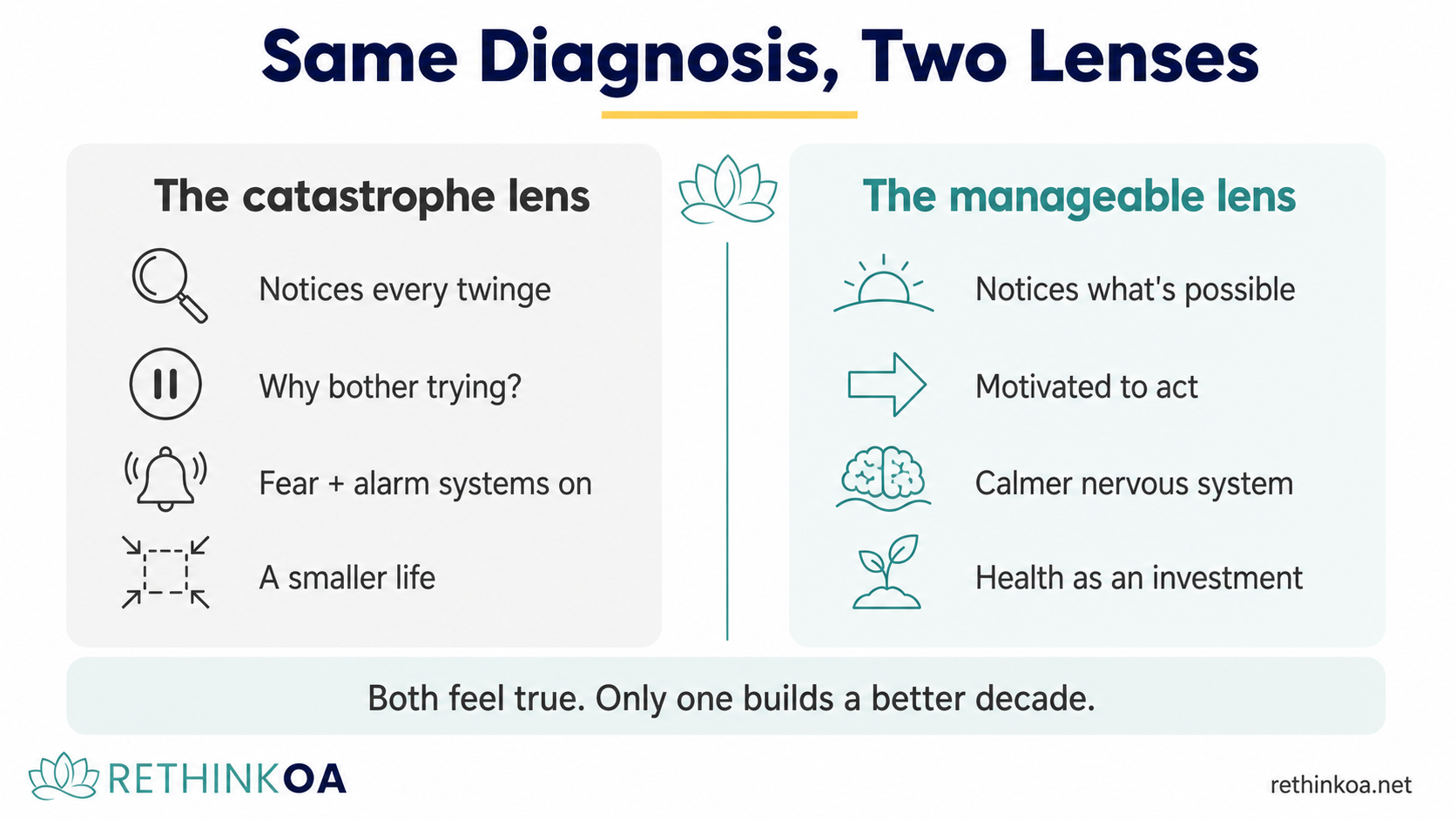
Consider two people with identical knees. One holds the mindset that most of our culture hands out with the diagnosis: osteoarthritis is a catastrophe—a one-way decline. That lens directs attention to every twinge, drains motivation (why bother if it only gets worse?), feeds anxiety, and keeps the body’s stress and protection systems switched on—which, as we’ve covered before, can amplify pain itself.
The other holds a different lens: osteoarthritis is manageable—and it’s a signal to take my health seriously. Not a blessing. A prompt. That lens notices evidence of capability, motivates action, and—this is the key part—is at least as accurate as the catastrophic one. Research consistently shows that osteoarthritis symptoms can improve, progression is generally slow, and many people improve without surgery. Neither mindset is a lie. But they produce very different lives.
The Wake-Up Call Effect
Here’s the pattern I find most moving. For many people, a diagnosis is the first time in decades they’ve been forced to pay attention to their bodies. And once they’re paying attention, some begin investing: strengthening muscles they’d ignored since their forties, walking daily, sleeping properly, eating better, reconnecting with friends on morning walks—each one a choice that benefits the whole body and mind, not just the knee.
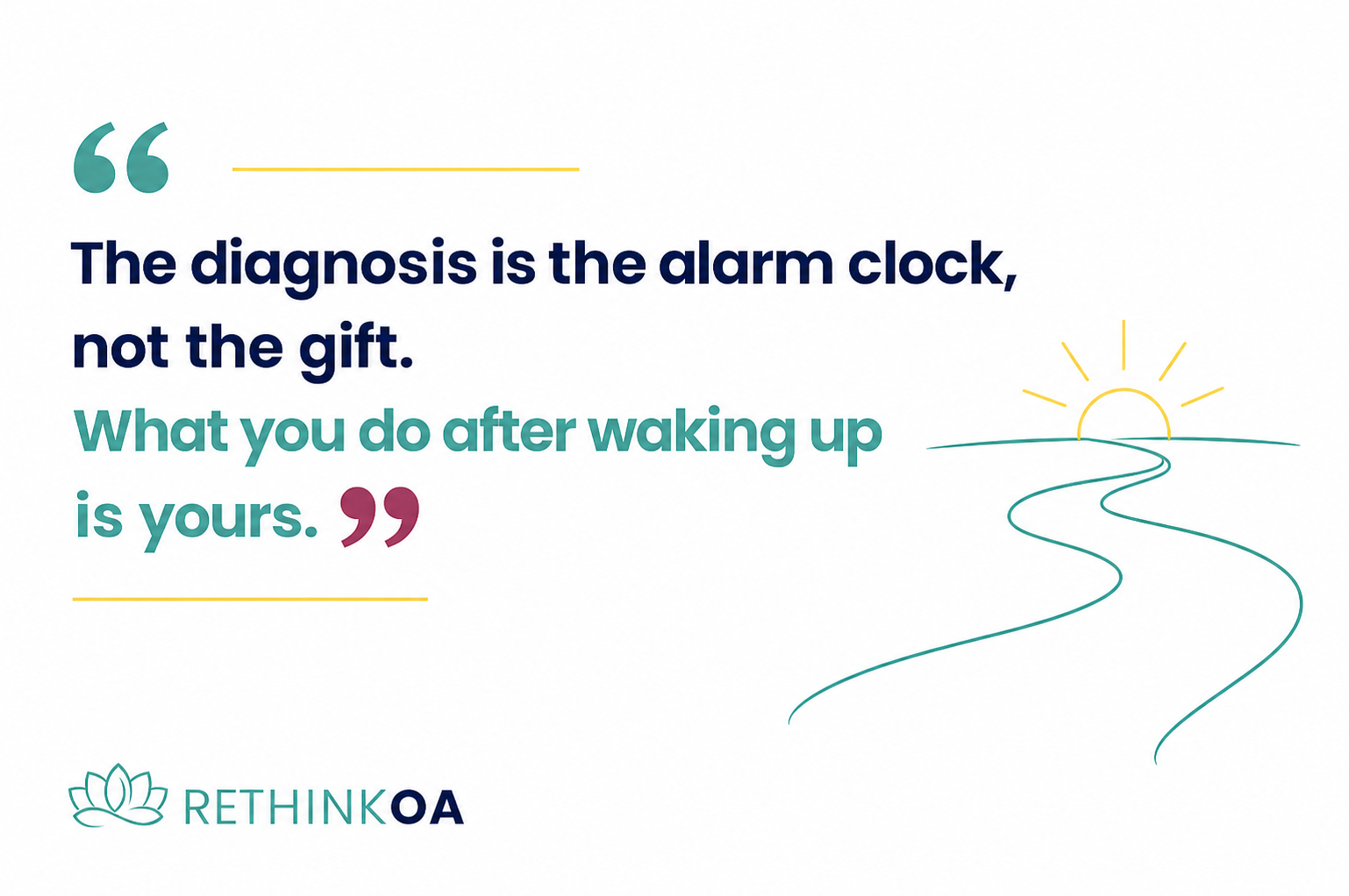
One participant in our program put it in a way I’ve never forgotten—she suspected she was in better overall shape after her diagnosis than before it, because she’d finally started treating her health as something to build rather than something to spend. That’s what “opportunity” means here. Not that osteoarthritis is good—but that the attention it demands can be redirected into genuinely good things. The diagnosis is the alarm clock, not the gift. What you do after waking up is yours.
What the Evidence Shows in Osteoarthritis
This isn’t just theory borrowed from milkshakes and hotels. In our clinical study of the Rethink OA program, published in npj Digital Medicine, we tested whether directly targeting mindsets—about osteoarthritis and about exercise—could change outcomes for people with knee osteoarthritis. Participants reported increased physical activity, reduced fear of movement, and a 44% reduction in their perceived need for surgery. The intervention contained no injections, no braces, no new exercise plan—just a structured shift in understanding, delivered in under two hours.
Mindset is not a cure, and it’s not the whole story—joints, muscles, sleep, and overall health all matter, and mindset works alongside them, not instead of them. But it may be the most overlooked tool in osteoarthritis care, and it’s one you already own. It also tends to be the tool that unlocks the others: confidence is usually what stands between knowing what helps and actually doing it.
If This Feels Like a Stretch Today
Maybe you’re reading this mid-flare, and “opportunity” still sounds absurd. That’s okay. This mindset isn’t a test you pass once; it’s a direction you drift over time, with practice. Start small: notice one thing your body did for you today. Take one action that treats your health as an investment—a ten-minute walk, an earlier bedtime, a call to a friend. You don’t have to believe the big idea yet. You just have to act like someone who’s waking up. The belief tends to follow the evidence you create.
Final Thoughts
Can osteoarthritis be an opportunity? Not the kind anyone asks for. But the research on mindsets—and the people I’ve watched live this—suggests the diagnosis carries a choice inside it. One lens turns life smaller: fewer activities, more fear, a body treated as a liability. The other turns attention into investment: strength, movement, sleep, connection, confidence. Same knee. Different decade ahead.
If you want a guided, evidence-based way to build that second lens, that’s exactly what Rethink OA is—developed at Stanford, tested in a clinical trial, and doable from your couch. Though we’ll have you off it shortly.
FAQ
Is it realistic to see osteoarthritis as an opportunity?
It depends what's meant. Pretending osteoarthritis is pleasant isn’t realistic—or helpful. But viewing the diagnosis as a manageable condition and a prompt to invest in your health is well supported: research shows symptoms can improve with exercise, weight management, sleep, and self-management, and many people become healthier overall after a diagnosis motivates lifestyle changes. The “opportunity” is in the response, not the disease.
Can mindset really affect physical health?
Research suggests it can. Studies have found that beliefs and framing influence measurable outcomes—from hormonal responses to food, to blood pressure changes with reframed work activity, to stress physiology. Specifically in knee osteoarthritis, a clinical trial of a mindset-based program reported increased physical activity, reduced fear of movement, and reduced perceived need for surgery. Mindset works alongside physical care, not instead of it.
Isn’t this just toxic positivity?
No—and the difference matters. Toxic positivity denies difficulty (“just be grateful!”). An opportunity mindset acknowledges the difficulty and asks what useful response it makes possible. It’s also grounded in accurate information: osteoarthritis progression is generally slow, symptoms are manageable, and improvement is common. Realism plus agency, not forced cheerfulness.
How do I start changing my mindset about osteoarthritis?
Three research-informed steps: notice the mindset you currently hold (without judging it), remember that other, equally valid lenses exist, and take one small action consistent with the lens you want—like a short walk or learning more about your condition. Actions generate the evidence that makes new mindsets believable. Education itself also shifts mindsets, which is why understanding pain science tends to reduce fear.
What if I’m too discouraged to think this way?
Discouragement is a normal part of living with a chronic condition, and mindset change isn’t about willpower. Start with self-kindness rather than reframing everything at once—we wrote a full guide on how to talk to yourself on discouraging days. And if low mood is persistent or heavy, talk with your doctor or a mental health professional; that support often makes everything else easier.
About the Author
Melissa Boswell, PhD, is a bioengineer and digital health founder with nearly a decade of experience working in osteoarthritis, movement science, and human performance. She is the founder of Rethink OA, a clinically validated digital program developed from research conducted with collaborators at Stanford University and published in npj Digital Medicine. Her work focuses on helping people better understand pain, movement, and behavior change in osteoarthritis.
References
- Crum AJ, Langer EJ. Mind-set matters: exercise and the placebo effect. Psychol Sci. 2007;18(2):165-171. https://doi.org/10.1111/j.1467-9280.2007.01867.x
- Crum AJ, Corbin WR, Brownell KD, Salovey P. Mind over milkshakes: mindsets, not just nutrients, determine ghrelin response. Health Psychol. 2011;30(4):424-429. https://doi.org/10.1037/a0023467
- Crum AJ, Salovey P, Achor S. Rethinking stress: the role of mindsets in determining the stress response. J Pers Soc Psychol. 2013;104(4):716-733. https://doi.org/10.1037/a0031201
- Boswell MA, et al. Mindset and physical activity intervention for adults with knee osteoarthritis. npj Digital Medicine. 2024. https://www.nature.com/articles/s41746-024-01281-8
- National Institute of Arthritis and Musculoskeletal and Skin Diseases (NIAMS). Osteoarthritis. https://www.niams.nih.gov/health-topics/osteoarthritis
Move More. Fear Pain Less.
Learn how to reduce pain, stay active, and support your joints—starting today.