
Growth Mindset and Osteoarthritis: What 30 Years of Learning Research Can Teach Your Knees
Oct 26, 2026
If you’ve raised kids or grandkids in the last two decades, you’ve probably heard of “growth mindset.” Teachers talk about it. Parenting books are built on it. The idea, from Stanford psychologist Carol Dweck, is simple: people who believe abilities can be developed tend to persist, learn from setbacks, and improve more than people who believe abilities are fixed.
Here’s what almost nobody has asked: what if we applied the same lens to our bodies—and specifically to a knee with osteoarthritis? Because when I listen to how people talk about their joints, I hear a lot of fixed mindset: “My knee is just worn out. This is what it is now. There’s nothing to develop.” This week, I want to borrow thirty years of learning research and point it at your knee—carefully, honestly, and with the evidence in hand.
What Growth Mindset Actually Means (and Doesn’t)
In Dweck’s classic studies, students who believed intelligence could grow showed improving grades across a difficult transition, while students who believed it was fixed plateaued—and a brief intervention teaching the “brain is like a muscle” idea shifted the trajectory. More recently, a national randomized study of more than 12,000 U.S. students, published in Nature, found that a short online growth-mindset program improved grades among lower-achieving students, with bigger effects in supportive school environments.
An honest caveat, because I care about getting this right: meta-analyses in education find the average effect of growth-mindset interventions is small—meaningful mainly for people who are struggling or at risk, and when the environment supports the new belief. That’s not a knock. It tells us where mindset matters most: when someone is stuck, discouraged, and surrounded by messages that they can’t change. Which describes a great many people with knee osteoarthritis.
The Fixed Mindset About Your Knee
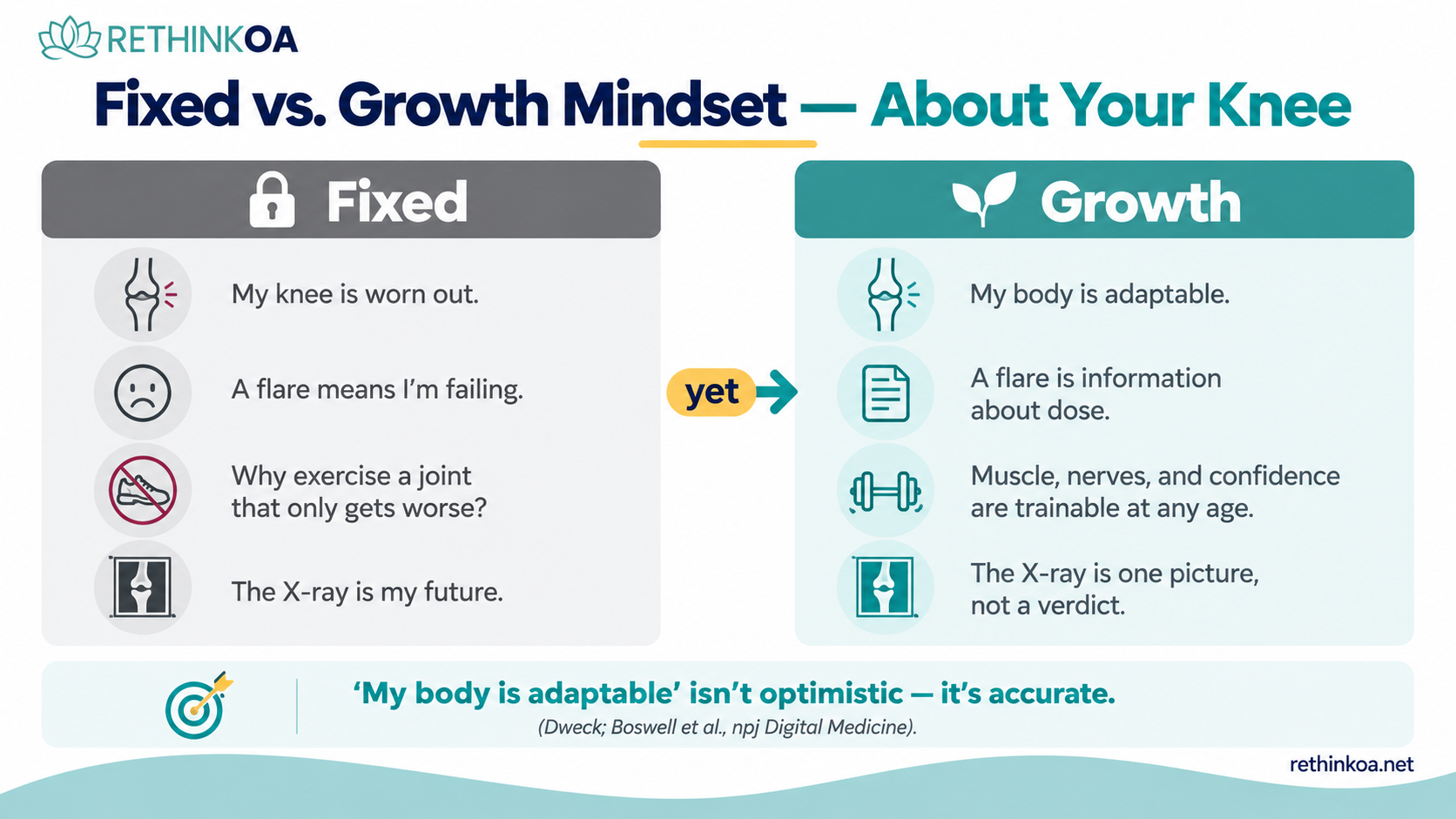
Osteoarthritis comes gift-wrapped in fixed-mindset language. “Wear and tear.” “Bone-on-bone.” “Degenerative.” “It only gets worse.” Every phrase implies your joint is a fixed quantity that can only decline—so effort is pointless and setbacks are proof. In our clinical trial, we measured something very close to this: the belief that “osteoarthritis is a catastrophe” versus “osteoarthritis is manageable.” The catastrophe mindset is, functionally, a fixed mindset about the body.
And it behaves the way fixed mindsets do everywhere. A flare becomes evidence of failure rather than information. Exercise feels futile (why train a joint that’s only going to get worse?). Avoidance feels rational. Confidence drains. The picture on the X-ray becomes destiny—even though, as we’ve seen repeatedly, the picture predicts remarkably little about pain or function.
Why a Growth Mindset About Your Body Is Actually Accurate
This is the part that matters: a growth mindset about your knee isn’t wishful thinking dressed up as psychology. It’s a more accurate description of your biology than the fixed version. Cartilage may not regrow—but nearly everything that determines how a knee feels and functions is trainable:
- Muscle gets stronger at any age; meta-analyses show resistance training improves pain and function in knee osteoarthritis, including in adults over 65
- The nervous system is plastic in both directions—it can become sensitized, and it can become less sensitive through graded movement, sleep, and understanding
- Fitness, balance, and confidence all respond to practice
- Cartilage itself is living tissue that responds to appropriate loading rather than being harmed by it
“My body is adaptable” isn’t the optimistic option. It’s the correct one. That’s why our program teaches “wear and repair” rather than “wear and tear”—and why the mindset shift in our trial was paired with increased physical activity, lower fear of movement, and a 44% drop in perceived need for surgery. Change the belief about whether growth is possible, and behavior follows.
Practicing a Growth Mindset With Osteoarthritis
Dweck’s research offers three habits that translate directly to joints. First, reframe setbacks as information, not verdicts. A flare after a long day isn’t proof your knee is failing; it’s data about dose, sleep, or stress. (Our flares post walks through this.) Second, praise process, not outcome. Growth-mindset teachers praise effort and strategy rather than “being smart.” Do the same for yourself: not “my knee was good today” but “I walked ten minutes and adjusted when it complained.” Third, add the word “yet.” “I can’t do stairs comfortably” becomes “I can’t do stairs comfortably yet”—a tiny edit that keeps the door open and, the research suggests, keeps you trying.
And remember the caveat from the education research: mindsets stick best in supportive environments. Surround yourself with people and sources who believe your body can adapt—a clinician who says “let’s build,” a friend who walks with you, a community that expects improvement.
Final Thoughts
We’ve spent thirty years learning that what students believe about their ability to grow shapes what they achieve—especially the ones who are struggling. Osteoarthritis hands people a fixed mindset about their bodies almost by default, and it costs them movement, confidence, and years of activity. The alternative isn’t a pep talk. It’s the truth: your muscles, nervous system, confidence, and yes, even your cartilage respond to what you do. Your knee is not a finished story. It’s a body that is still, at every age, capable of growth.
Building that mindset—with the science to back it—is exactly what Rethink OA does, and what we tested in a randomized trial.
FAQ
What is a growth mindset?
A growth mindset is the belief that abilities can be developed through effort, strategy, and support, rather than being fixed traits. Research from psychologist Carol Dweck and colleagues links growth mindset to greater persistence and improvement, especially among people who are struggling. A fixed mindset is the belief that abilities are set and can’t meaningfully change.
How does growth mindset apply to osteoarthritis?
Osteoarthritis is often described in fixed-mindset terms (“wear and tear,” “only gets worse”), which discourages the very behaviors—exercise, strength work, staying active—that help. A growth mindset about the body recognizes that muscle, nervous-system sensitivity, fitness, and confidence are all trainable at any age. In a randomized trial, shifting from an “osteoarthritis is a catastrophe” to an “osteoarthritis is manageable” mindset was associated with more physical activity and less fear of movement.
Isn’t growth mindset just positive thinking?
No. Growth mindset is about how you interpret setbacks and effort, not about forced optimism. Applied to the body, it’s also simply more accurate: research shows strength, fitness, and pain sensitivity are changeable, and appropriately loaded cartilage adapts rather than wearing out. The caveat is that mindset works alongside action and supportive environments—not instead of them.
Does growth mindset really work? What does the research say?
Education meta-analyses find modest average effects, with larger benefits for students who are struggling or at risk and in supportive environments. A national randomized study in Nature found a short online program improved grades among lower-achieving students. The lesson for osteoarthritis: mindset interventions matter most for people who feel stuck and discouraged—and they work best paired with real support and action.
How can I develop a growth mindset about my knee pain?
Three research-informed habits: treat flares as information about dose and recovery rather than verdicts; praise your process (“I walked and adjusted”) rather than judging outcomes; and add “yet” to limitations (“I can’t do stairs comfortably yet”). Surround yourself with clinicians and people who expect your body to adapt.
About the Author
Melissa Boswell, PhD, is a bioengineer and digital health founder with nearly a decade of experience working in osteoarthritis, movement science, and human performance. She is the founder of Rethink OA, a clinically validated digital program developed from research conducted with collaborators at Stanford University and published in npj Digital Medicine. Her work focuses on helping people better understand pain, movement, and behavior change in osteoarthritis.
References
- Blackwell LS, Trzesniewski KH, Dweck CS. Implicit theories of intelligence predict achievement across an adolescent transition: a longitudinal study and an intervention. Child Dev. 2007;78(1):246-263. https://doi.org/10.1111/j.1467-8624.2007.00995.x
- Yeager DS, et al. A national experiment reveals where a growth mindset improves achievement. Nature. 2019;573:364-369. https://doi.org/10.1038/s41586-019-1466-y
- Sisk VF, et al. To what extent and under which circumstances are growth mind-sets important to academic achievement? Two meta-analyses. Psychol Sci. 2018;29(4):549-571. https://doi.org/10.1177/0956797617739704
- Dweck CS. Mindset: The New Psychology of Success. Random House; 2006.
- Bricca A, et al. Impact of exercise on articular cartilage in people at risk of, or with established, knee osteoarthritis. Br J Sports Med. 2019;53(15):940-947. https://bjsm.bmj.com/content/53/15/940
- Boswell MA, et al. A randomized clinical trial testing digital mindset intervention for knee osteoarthritis pain and activity improvement. npj Digital Medicine. 2024. https://www.nature.com/articles/s41746-024-01281-8
Move More. Fear Pain Less.
Learn how to reduce pain, stay active, and support your joints—starting today.