
Why You Don't Feel Like Exercising (And Why That's Not a Character Flaw)
Oct 19, 2026
Here’s a confession you might recognize: most days, I don’t feel like exercising. I know the research inside and out. I built a program about movement. And still, when the moment comes, part of me would rather stay on the couch. For years I assumed that meant something was wrong with me—a discipline gap, a character flaw, a lack of the “fitness gene” other people seemed born with.
Then I learned what evolutionary biologists have been saying for a while, and it changed how I talk to myself—and how I talk to people with knee osteoarthritis who feel guilty for not wanting to move. The short version: not wanting to exercise isn’t a flaw. It’s your biology working exactly as designed. Understanding why makes it far easier to move anyway.
We Never Evolved to Exercise
For almost all of human history, physical activity wasn’t optional and it wasn’t recreational—it was how you ate, found water, and stayed safe. Because calories were scarce and hard-won, evolution favored people who didn’t waste energy. Harvard evolutionary biologist Daniel Lieberman makes this case in his book Exercised: humans evolved deep instincts to avoid unnecessary exertion and to rest whenever rest was available. Voluntary exercise—spending calories for no immediate purpose—is a modern invention. Of course it feels unnatural. It is unnatural.
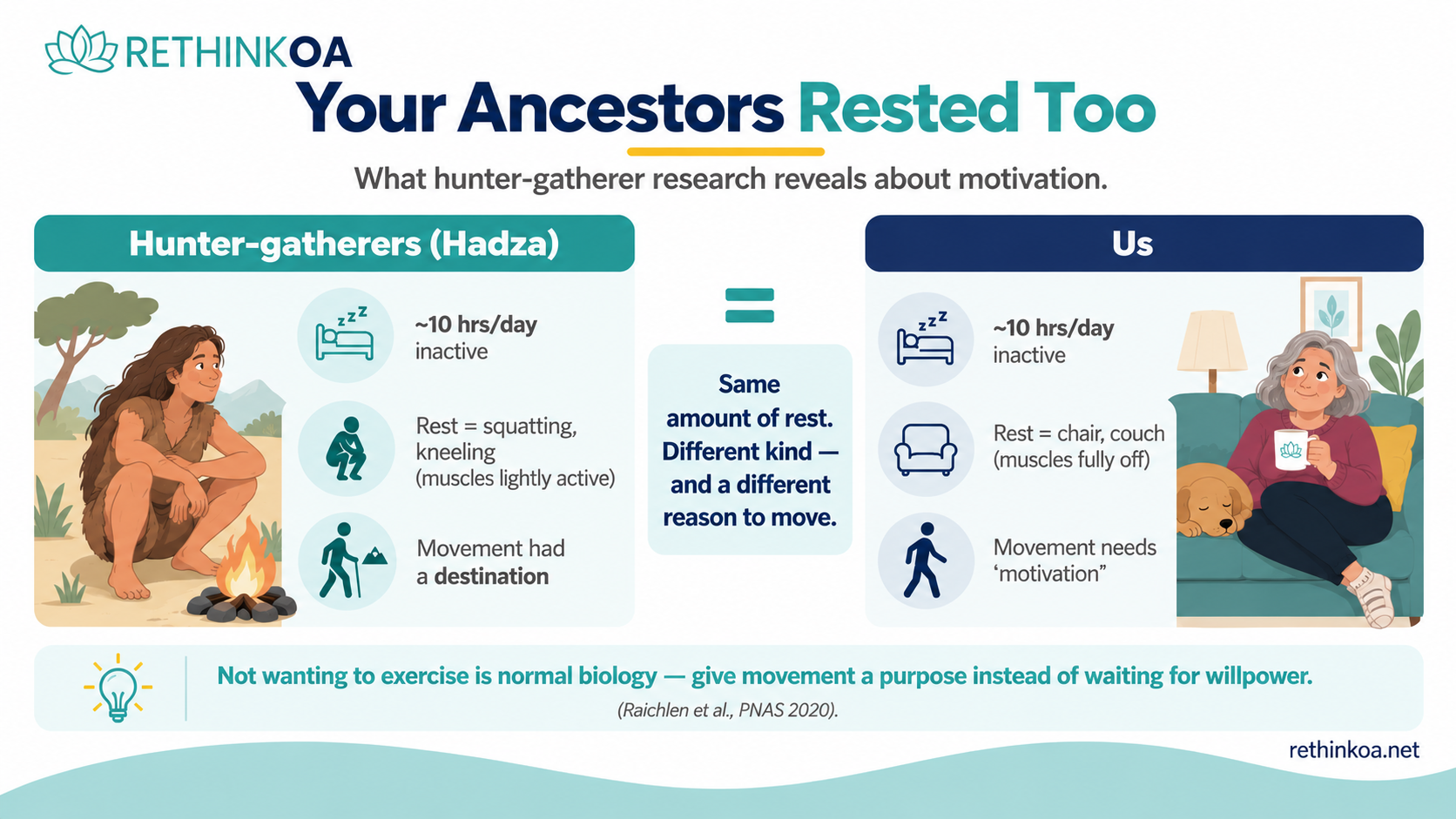
The data bear this out in surprising ways. When researchers fitted the Hadza—one of the last hunter-gatherer populations, in Tanzania—with activity monitors, they found that Hadza adults spend about ten hours a day being physically inactive—roughly the same as people in industrialized countries. Our ancestors weren’t in perpetual motion. They rested a lot, because resting made sense.
So What Was Different? The Shape of Rest and the Reason to Move
Two things separated their inactivity from ours. First, how they rested: the Hadza spend much of their downtime squatting or kneeling—“active rest” postures that keep leg muscles gently working—rather than slumped in chairs. The researchers proposed an “inactivity mismatch hypothesis”: our bodies may be adapted to rest that still involves light muscle activity, and long stretches of totally passive sitting are the modern problem, not rest itself.
Second, why they moved: activity was woven into necessity. Nobody had to summon motivation to go for a walk; the walk had a destination. That’s the piece I find most useful. Your reluctance to “go exercise” isn’t weakness—it’s a perfectly reasonable ancestral brain asking, “Why would we spend energy for no reason?” The fix isn’t more willpower. It’s giving the movement a reason.
What This Means If You Have Knee Osteoarthritis
If movement already carries some discomfort or worry, the ancestral “why bother?” voice gets even louder—and the guilt that follows makes everything worse. Research on self-criticism suggests that harsh self-talk tends to reduce follow-through, not increase it (we covered this in how to talk to yourself when osteoarthritis feels discouraging). So the first move is simply to stop moralizing the couch. You don’t lack discipline. You have a normal human brain that is very good at conserving energy.
Then work with that brain instead of against it. Three approaches that fit our evolutionary wiring—and the evidence:
- Give movement a destination. Walk to the store if it’s walkable. Take the letter to the mailbox. Carry the groceries in two trips. Purpose bypasses the “why bother” circuit entirely—which is the heart of last week’s post on movement as texture, not checklist.
- Make rest more “active.” Stand for phone calls. Sit on a firmer chair. Break long sitting with a lap around the room. You’re not adding exercise; you’re restoring the low-level muscle activity our bodies seem to expect.
- Attach it to something you already do—and enjoy. Habit research shows behaviors cued by an existing routine become automatic, which removes the motivation decision altogether. And enjoyment—a walk with a friend, music, a scenic route—gives the ancestral brain a reward it recognizes.
You Don’t Have to Want To. You Just Have to Start.
One more piece of good news from the science of motivation: for most people, the desire to move arrives after they begin, not before. Motivation is unreliable as a starting signal and quite reliable as a reward. So stop waiting to feel like it. Start small enough that not feeling like it doesn’t matter—a five-minute walk, a few sit-to-stands—and let the wanting catch up. As we saw in the largest analysis of exercise for knee osteoarthritis, even simple walking ranks among the most effective things you can do. It doesn’t require enthusiasm. It just requires shoes.
Final Thoughts
Not feeling like exercising is not a moral failing—it’s a 200,000-year-old energy-saving instinct doing its job in a world where energy is no longer scarce. Once you see it that way, the guilt loses its grip, and you can do what our ancestors did without ever calling it exercise: move because there’s a reason to, rest in ways that keep the body gently engaged, and let enjoyment and habit carry what willpower never could. You were never broken. You were just built for a different world—and you can still thrive in this one.
If fear of pain is part of what keeps you on the couch, Rethink OA was designed and clinically tested to change exactly that.
FAQ
Why don’t I feel motivated to exercise even though I know it helps?
Because humans evolved to conserve energy. For nearly all of our history, physical activity was necessary for survival and calories were scarce, so instincts that avoid unnecessary exertion were advantageous. Voluntary exercise is a modern invention, and the reluctance most people feel is normal biology—not a lack of discipline. The practical response is to give movement a purpose, attach it to existing habits, and make it enjoyable rather than relying on willpower.
Did our ancestors really rest as much as we do?
Research suggests yes. Accelerometer studies of the Hadza hunter-gatherers found about ten hours a day of non-walking, inactive time—similar to industrialized populations. The difference was the form of rest (more squatting and kneeling, which keep leg muscles lightly active) and that their movement had built-in purpose.
Is it bad to sit a lot if I have knee osteoarthritis?
Long, uninterrupted sitting tends to stiffen osteoarthritic joints and is associated with weaker muscles over time. The research on “active rest” suggests the issue is less about resting and more about resting completely passively for hours. Breaking up sitting with short movement, standing, or position changes helps—without needing a formal workout.
How do I exercise when I have no motivation?
Don’t wait for motivation—for most people it arrives after starting, not before. Shrink the first step until it’s almost too small to resist (five minutes, a few sit-to-stands), attach it to a routine you already have, and choose something with purpose or enjoyment built in. Research suggests cued, repeated behaviors become automatic over time, removing the daily motivation decision.
Does feeling guilty about not exercising help me do more?
Research suggests the opposite: self-criticism tends to increase distress and reduce follow-through, while self-compassion is associated with better persistence. Understanding that reluctance is normal biology makes it easier to respond kindly—and then simply start small.
About the Author
Melissa Boswell, PhD, is a bioengineer and digital health founder with nearly a decade of experience working in osteoarthritis, movement science, and human performance. She is the founder of Rethink OA, a clinically validated digital program developed from research conducted with collaborators at Stanford University and published in npj Digital Medicine. Her work focuses on helping people better understand pain, movement, and behavior change in osteoarthritis.

References
- Raichlen DA, Pontzer H, Zderic TW, et al. Sitting, squatting, and the evolutionary biology of human inactivity. Proc Natl Acad Sci USA. 2020;117(13):7115-7121. https://doi.org/10.1073/pnas.1911868117
- Lieberman DE. Exercised: Why Something We Never Evolved to Do Is Healthy and Rewarding. Pantheon; 2021.
- Lally P, van Jaarsveld CHM, Potts HWW, Wardle J. How are habits formed: modelling habit formation in the real world. Eur J Soc Psychol. 2010;40(6):998-1009. https://doi.org/10.1002/ejsp.674
- Wren AA, et al. Self-compassion in patients with persistent musculoskeletal pain. J Pain Symptom Manage. 2012;43(4):759-770. https://www.sciencedirect.com/science/article/pii/S0885392411004088
- Yan L, et al. Comparative efficacy and safety of exercise modalities in knee osteoarthritis: systematic review and network meta-analysis. BMJ. 2025;391:e085242. https://doi.org/10.1136/bmj-2025-085242
- Boswell MA, et al. A randomized clinical trial testing digital mindset intervention for knee osteoarthritis pain and activity improvement. npj Digital Medicine. 2024. https://www.nature.com/articles/s41746-024-01281-8
Move More. Fear Pain Less.
Learn how to reduce pain, stay active, and support your joints—starting today.